
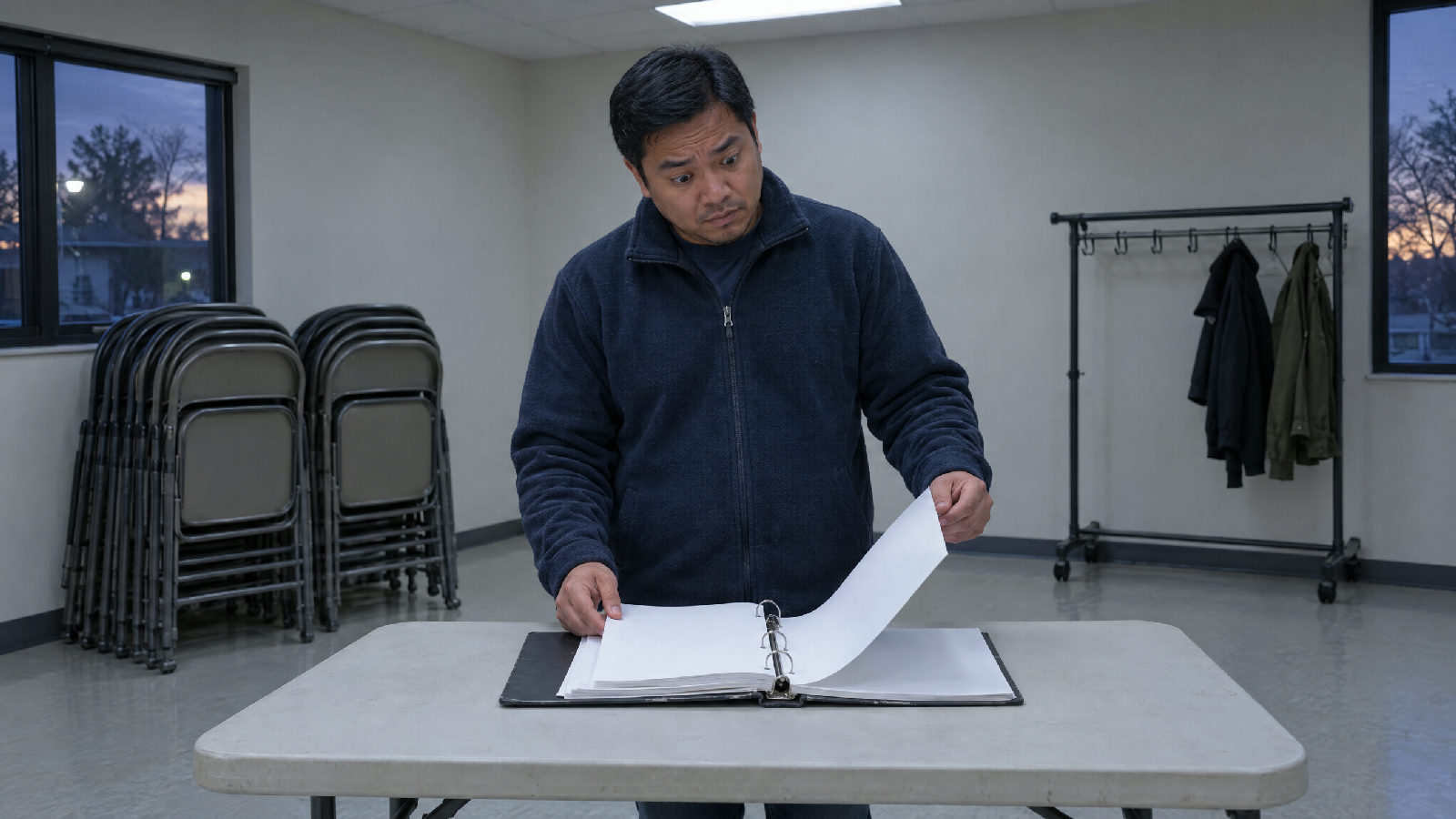
Six months after the last treasurer stepped down, someone finally needs the reserve study. It's not in the shared drive. It's not in the binder the outgoing treasurer left on a folding table at the last meeting. It's in an email attachment, buried in a personal Gmail account that belonged to a volunteer who moved out of state in the spring and stopped answering board texts in June.
Nobody did anything wrong here. The treasurer didn't hoard the file on purpose. She just never had a reason to put it anywhere else — for three years, "ask me" was a perfectly good filing system, right up until the day it wasn't.
Monday's piece made the case that an empty board seat is a job-description problem, not a volunteer shortage — that seats accumulate duties nobody ever removes, and every departure restarts the learning curve from zero. That raises the obvious next question: why does the learning curve reset to zero? Why doesn't a board just... know what it knew last year?
The answer is more specific than "poor communication," and it's worth naming precisely, because you can't fix a problem you've only described vaguely.
The knowledge was never in the board. It was in a person.
Software teams have a blunt name for this exact failure mode: the bus factor. It's the number of people who'd have to disappear — quit, get hit by a bus, whatever — before a project grinds to a halt because nobody left understands how it actually works. A bus factor of one means the entire operation depends on a single head. Engineers treat that as an emergency, not a personnel footnote, because a bus factor of one isn't really a risk about buses. It's a diagnosis: the knowledge was never distributed in the first place. It just looked distributed, because the one person who had it was always around to answer questions.
Most self-managed HOA boards are running a bus factor of one on at least two or three seats right now, and almost nobody would describe it that way. They'd say "Karen handles the finances" or "just call Dave, he knows the pool contract inside and out." That sounds like a strength — a board member who really owns their role. It's also, structurally, the exact same condition a software team calls a five-alarm risk.
Key person risk Business finance has its own name for it: key person risk, or key person dependency — the condition where critical knowledge, relationships, or decisions are concentrated in one individual instead of spread across the organization. It's real enough that businesses buy insurance against it. Nobody sells HOA boards that insurance, because the "key person" in this case is an unpaid volunteer who was never told they'd become one.
Why "just document it" doesn't happen on its own
Here's the part that's easy to miss: informal knowledge-holding works, right up until it doesn't. That's precisely why it never gets fixed in advance. As long as the treasurer is still on the board, "ask her" is faster than writing a manual, and it produces a correct answer every time. There's no moment where the system visibly fails — no error message, no missed payment — that would prompt someone to say "we should write this down." The failure is invisible until the person who held the knowledge is gone, and by then it's not a maintenance task anymore. It's an investigation.
That asymmetry is the actual mechanism behind "the learning curve restarts from zero." It's not that boards are careless. It's that the cost of not documenting something is deferred entirely onto whoever holds the seat next — a person who, by definition, isn't in the room yet to argue for spending time on it now.
And what actually goes missing isn't just facts. Anyone can eventually find the account number for the landscaping vendor. What doesn't survive a handoff is the why: why the board stopped using the low bidder two years ago, why the insurance renewal always gets filed a week early, why one homeowner's fence variance is a permanent exception nobody wants to relitigate. None of that lives in a spreadsheet. It lives in a person's memory of a decision nobody wrote down — which makes holding it, quietly, an unlisted qualification for the seat. You don't just need to be willing to do the treasurer's job. You need three years of context nobody handed you, and the only way to get it used to be living through it.
Even the vendors who sell to boards tell them to fix this
This isn't a fringe concern. The HOA-management industry's own how-to content — written by companies with every incentive to make self-management look harder than it is — keeps landing on the same advice. TownSq's own board-transition guide recommends building a board binder, physical or digital, before anyone leaves, specifically so the community isn't dependent on one departing person's memory. PayHOA's succession-planning material goes further and says the quiet part directly: "If your processes are clear and well-documented, any organized volunteer can step into the role and succeed" — no professional background required. HOA Management's own transition checklist calls for scheduling a meeting between the outgoing and incoming person in the same role before the handoff, specifically so institutional context transfers person-to-person while both people are still reachable, not after one of them is gone.

Strip away the vendor framing and the advice is simply correct: the fix for a bus factor of one is never "hope the next person is smart." It's capturing the knowledge while the person who has it is still around to check your work — and putting it somewhere the next three people can find it, not just the next one.
What actually needs to survive the handoff
Not everything on a board seat is knowledge worth documenting. Some of it is judgment — a live decision a human has to make in the moment, and no binder replaces that. What needs to survive a departure is the recurring, rules-based layer underneath the judgment: where things live, how the recurring tasks actually get done, and the unwritten exceptions that would otherwise take a newcomer a full year of embarrassing mistakes to rediscover on their own.
That's a narrower list than "write down everything you know," which is exactly why almost nobody attempts it. "Everything you know" is an infinite, unfinishable task, so it never starts. A bounded list — the handful of things that would actually strand your successor if you vanished tomorrow — is finishable in one sitting.
We built that as a free one-page template: The Handoff Sheet. It's not a full manual. It's five short sections a current board member fills out about their own seat, in about twenty minutes, covering exactly what a bus-factor audit says matters: where the recurring work actually lives, how to do the three things that come up every month, the unwritten exceptions a newcomer would otherwise have to rediscover the hard way, who to call when something breaks, and the one thing the outgoing member wishes someone had told them on day one. Fill it out once, while you're still in the seat, and the next person inherits three years of context instead of a folding-table binder and a phone number that may or may not still work.
The Handoff Sheet: five short sections, about twenty minutes, about your own seat.
- Where the recurring work actually lives
- How to do the three things that come up every month
- The unwritten exceptions
- Who to call when something breaks
- The one thing the outgoing member wishes someone had told them on day one
The takeaway
A board doesn't lose institutional knowledge because volunteers are forgetful or careless. It loses it because the knowledge was structurally located in exactly one place — a person's head — and nothing forced it out into the open before that person left. That's a design problem, the same one Monday's piece named in the seat itself: a job quietly grows until it requires things nobody wrote into the description, and "three years of unrecorded context" is one of the heaviest, least visible ones.
The failure is invisible until the person who held the knowledge is gone, and by then it's not a maintenance task anymore. It's an investigation.
You don't fix a bus factor of one by hoping the next volunteer is a fast learner. You fix it by moving the knowledge out of the person and into something the community actually owns — while the person who has it is still there to hand it over on purpose, instead of leaving it behind by accident.
If you're currently serving, this week's assignment is small: fill out the Handoff Sheet for your own seat, even if you have no plans to leave. Twenty minutes now is cheaper than a six-month reserve-study hunt later.