
The short answer
- Usually not. If no one will serve, dissolving the HOA's corporation still does not, by itself, end the recorded covenants or hand off the common property. In North Carolina, ending a planned community created since 1999 takes owners holding at least 80% of the votes (N.C.G.S. § 47F-2-118).
- The property keeps its calendar. Insurance renews, contracts roll over, inspections come due and the tax return is still owed, whether or not anyone ran.
- Someone can still act. In North Carolina, directors whose terms ran out keep serving until replaced (N.C.G.S. § 55A-8-05(d)), and in Florida, if the board cannot fill enough seats for a quorum, one owner can ask a court for a receiver the association pays for (Fla. Stat. § 720.3053). Name a person for each duty below before the next bill arrives.
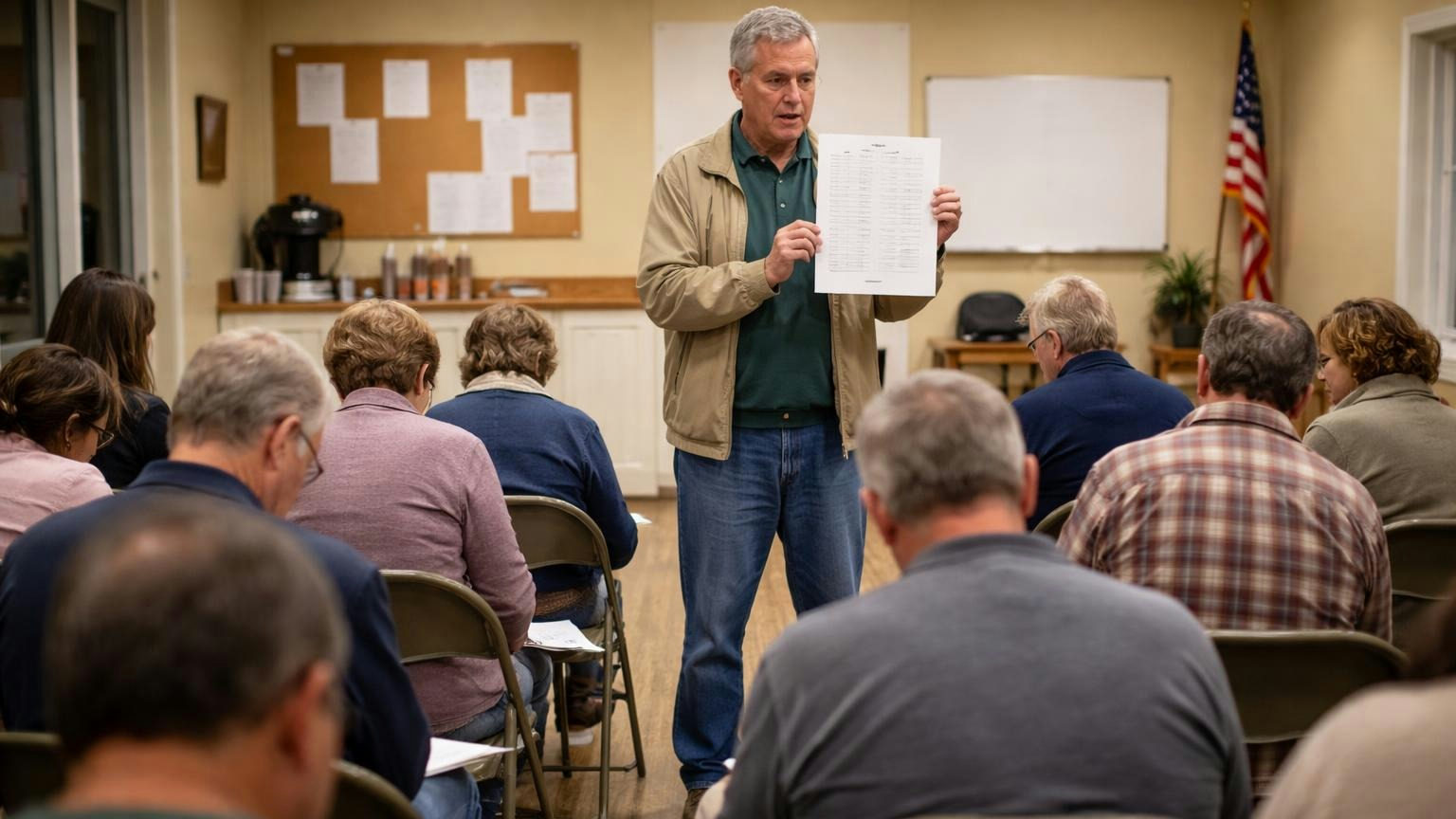
The question usually comes near the end of the annual meeting, after the call for candidates meets silence. Someone in the third row asks it, not unkindly: if nobody wants to run this thing, can't we just dissolve the HOA?
It is a fair question, and the road at the entrance does not know whether anyone ran. Neither does the retention pond, the pool's operating permit, the insurance policy that renews next month, or the landscaping contract that rolls over by itself if nobody sends a letter. The obligations attached to common property keep their own calendar. What changes when the board stalls is only whether anyone is watching it.
This is general information, not legal advice. Your declaration, your bylaws, your state's law and your association's attorney decide what applies to you.
Can we dissolve: The road is still there
"Dissolve the HOA" can mean three different things, and only one of them is easy.
The corporation. Most associations are nonprofit corporations, and a corporation can be dissolved, sometimes by accident. In Florida, the state may administratively dissolve a nonprofit that fails to file its annual report and pay the fee by the third Friday in September (Fla. Stat. § 617.1420(1)(a)); the report is due between January 1 and May 1 each year (§ 617.1622(4)). Dissolving the corporation does not dissolve the land underneath it. A Florida association can apply for reinstatement at any time, and reinstatement relates back as if the dissolution never happened (§ 617.1422).
The covenants. The declaration is recorded against every lot, and it does not expire because nobody ran. Ending it is a vote of owners, at a threshold the law or the declaration sets. In North Carolina, a planned community created on or after January 1, 1999 (N.C.G.S. § 47F-1-102) "may be terminated only by agreement of lot owners of lots to which at least eighty percent (80%) of the votes in the association are allocated, or any larger percentage the declaration specifies," signed like a deed and recorded (N.C.G.S. § 47F-2-118(a), (b)). A community that cannot fill three seats is unlikely to gather 80% of its owners' signatures.
The common property. Even after a termination, the land goes somewhere. North Carolina's statute says the common elements are either sold under the termination agreement or vest in the lot owners "as tenants in common" (§ 47F-2-118(c), (e)). Either way, somebody still owns the pond.
Handing it to the city? Generally, a road or a pond becomes public only if a public body agrees to take it, and it may set conditions first. Ask your city or county's public works department what it requires before anyone promises owners it will happen.
The calendar: What keeps coming due
Here is what tends to keep running on its own schedule. Your list will differ, so treat this as the list of questions to answer, not the answers.
| What keeps coming due | What happens if nobody acts | Who usually holds it today |
|---|---|---|
| Property and liability insurance renewal | The policy can lapse at renewal if nobody pays or signs | The treasurer or president, by email from the agent |
| Service contracts (landscaping, pool, trash, snow) | Some renew on their own unless someone sends notice in time | Whoever signed the last one |
| The stormwater pond maintenance agreement | Some agreements let the local government inspect, repair and bill the association; read yours | Often nobody: it sits in the deed records |
| The pool's operating permit and inspection, where your county requires one | No permit, no opening day | The pool contractor and one board member |
| The federal tax return (Form 1120-H or 1120) | Form 1120-H is generally due by the 15th day of the 4th month after the tax year ends (IRS, Instructions for Form 1120-H) | The treasurer or an outside preparer |
| The state annual report, where your state requires one | In Florida, it can lead to administrative dissolution (Fla. Stat. § 617.1420) | The president or registered agent |
| Property tax and utility bills on common areas | Penalties and shutoffs, in that order | Whoever gets the mail |
The pond row deserves a second look. A recorded stormwater agreement is an obligation of the association, not of whoever happens to be on the board, and some give the local government a right to repair and charge the cost back. We read one clause by clause here:
HOA Stormwater Pond Maintenance Agreement: 5 Clauses to Read
Who can act: People the law already names
When the meeting fails, owners often assume the association is frozen. In many states it is not, and the law names who may keep it moving.
The directors who were already serving. In North Carolina, "despite the expiration of a director's term, the director continues to serve until the director's successor is elected, designated, or appointed and qualifies" (N.C.G.S. § 55A-8-05(d)). If your state and bylaws say the same, last year's board is still the board.
The remaining directors, filling seats. In North Carolina, the remaining directors, even a single director, may fill a vacancy, including one left by members failing to elect a full board, unless the articles or bylaws provide otherwise (N.C.G.S. § 55A-8-11(a)(3)). In Florida, the remaining directors or the sole remaining director may fill a vacancy that occurs before a term ends, unless the bylaws provide otherwise (Fla. Stat. § 720.306(9)(c)); whether that reaches a seat left empty by a failed election is a question for your attorney. A willing owner who would not stand for election will sometimes accept an appointment for the rest of a term.
A receiver, in Florida. If a Florida association fails to fill enough vacancies to make a quorum under its bylaws, any member may give 30 days' notice and then ask the circuit court to appoint a receiver (Fla. Stat. § 720.3053(1)-(3)). The receiver has "all powers and duties of a duly constituted board of directors" (§ 720.3053(5)). The same subsection says who pays:
The association shall be responsible for the salary of the receiver, court costs, and attorney's fees. — Florida Statutes § 720.3053(5)
That sentence is the real answer to the third-row question. A receiver can keep the pond inspected and the insurance paid, and every owner's assessments pay a stranger to do it.
Everyone else: your documents decide. Officers, committees, the managing agent if there is one, and what any of them may sign without a board vote are set by your bylaws and contracts. Where those are silent, ask your attorney before anyone signs.

The duties: Keep these covered through a failed election
Write a name and a backup next to each line before the next bill arrives. Where a line needs board authority, write which section of your bylaws gives it, or "ask the attorney".
- Insurance: who receives the renewal, and who may sign and pay it.
- Contracts: every service contract, its renewal date and its notice deadline, in one list.
- Inspections and permits: the pool, the pond, the playground, the backflow tests, with their due dates.
- Taxes and filings: the federal return, the state annual report and the property tax, with who files each.
- The bank: who can see the account, and who can pay a bill if the usual signer is away.
- Emergencies: who calls the plumber, the tree service or the utility at 2 a.m., and how much they may approve.
- The seats: the bylaw section on filling vacancies, and the name of one owner willing to be asked.
Frequently asked questions
Can we just stop paying dues if nobody runs? In most communities the covenant to pay assessments is in the recorded declaration, so it does not end because the board stalled. The bills for the common property also do not stop. Your declaration and your attorney decide what happens if assessments go uncollected.
What if our insurance lapses while we sort this out? Call the agent now and ask who is on the account and when the renewal is due. A lapse is far easier to prevent than to explain after a claim.
Can a few owners act without a board? Usually only within what your bylaws allow, such as calling a special meeting. In Florida, if the board cannot fill enough seats for a quorum, any member may start the receivership notice in Fla. Stat. § 720.3053. Elsewhere, your governing documents and your attorney decide.
The common property does not wait for an election. The only question is whether the next bill lands on a name or on nobody.