
A South Carolina HOA board has four concrete legal duties, not forty. They come from one law — the South Carolina Homeowners Association Act (S.C. Code Title 27, Chapter 30), effective May 17, 2018 — and every one of them is a scheduling and record-keeping problem, not a management problem.
That gap matters, because it's the opposite of what most volunteer boards believe. Somewhere along the way, "legal compliance" got filed in the same mental folder as "professional management" — as if a board can't be legitimate unless it's paying someone else to be legitimate for it. It's a natural leap. Nobody hands a new board member the statute. They inherit a binder, a login, and a vague sense that something out there could go wrong.
Here's the correction: the law does not require a management company. It requires a board that does four specific, knowable things, reliably, every time. A system does that better than a person remembering to check a calendar — which is the whole point of this week's argument: professionalism is infrastructure, not headcount.
The four things South Carolina law actually requires
This is not the complete text of the Act, and it is not legal advice — treat it as a map of the load-bearing walls, then check your own declaration and bylaws, which can add requirements the state law doesn't. Here's what the statute itself puts on a board:
1. Record your governing documents properly, or they don't hold up. Under § 27-30-130, a homeowners association's governing documents — and any rules, regulations, or amendments to them — are only enforceable if they're recorded in accordance with the Act's requirements. A rule your board never properly recorded is a rule a homeowner can ignore and win. This is the one boards skip most often, because it sounds like paperwork instead of governance. It's actually the foundation everything else stands on.

2. Give real notice before a board meeting. § 27-30-350 requires notice of the time, date, and place of every board meeting — and every meeting of a board subcommittee or committee — to be posted somewhere reasonably calculated to reach a majority of lot owners. "We texted a few people" doesn't meet that bar. A posted, dated, findable notice does.
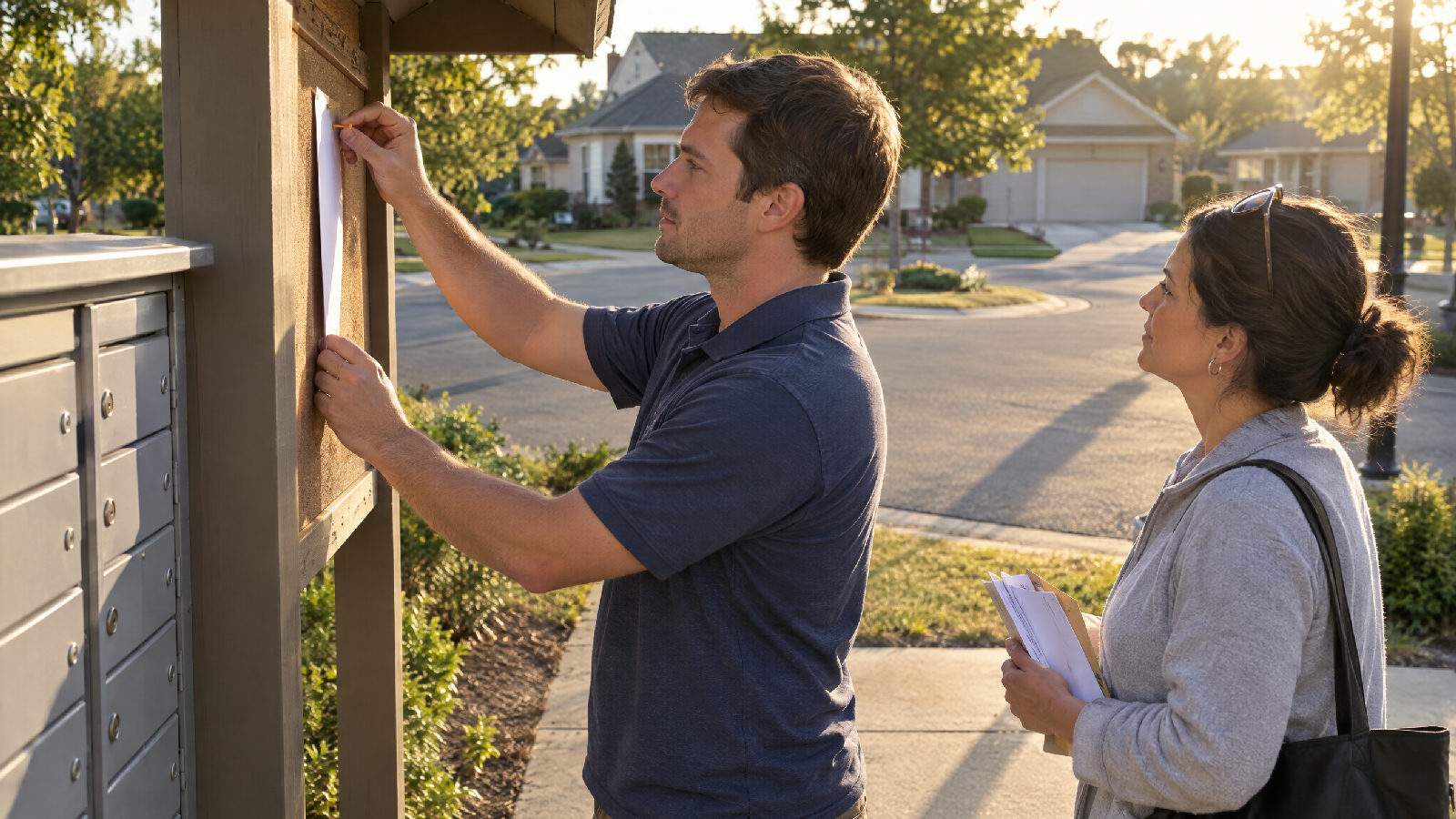
3. Give 48 hours' notice before voting to raise the annual budget. § 27-30-140 sets a specific floor: before a homeowners association can act to increase its annual budget in a given year, it has to notify homeowners at least 48 hours before the meeting where that vote happens. This is a hard deadline with a specific number attached to it — exactly the kind of thing a volunteer, juggling a day job, is most likely to blow past by accident.
4. Keep your rule changes and budget actions inside what your documents actually allow. The Act works alongside your declaration and bylaws, not instead of them — governing-document requirements (annual meeting timing, quorum, who can vote on what) still apply, and the Act's recording and notice rules layer on top of them. A board that knows its own documents, and follows them consistently, is doing the job the law asks for.
That's the statutory core. Four items. None of them require a payroll.
What the law does not require
This is where a lot of the "we need a management company to be compliant" anxiety comes from — assuming duties that aren't actually on the books.
- No mandatory reserve study. As of this writing, South Carolina does not require HOAs to commission a reserve study or maintain any minimum funded-reserve level. The Act allows a board to establish a reserve account; it doesn't order one. (A bill in the 2025–2026 legislative session, S.C. Bill 5204, has proposed requiring reserve studies every three years with 100%-funded reserves for new HOAs — that is proposed legislation, not current law, and it's worth a board's attention precisely because it isn't settled yet.)
- No statewide insurance mandate from the Act itself. Insurance requirements for a South Carolina HOA typically come from the association's own governing documents, its mortgage lender, or its master policy — not from Chapter 30 directly.
- No requirement to hire a licensed manager. Nothing in the Act conditions an association's legal standing on outsourcing its operations. Self-managed and professionally-managed associations answer to the same statute.
Legitimacy was never the manager's to sell.
Why this reframes "professional"
Put the four real duties next to what a management company actually sells a board, and the mismatch is obvious. A manager's pitch is "we'll remember to do this for you." But recording a document, posting a meeting notice, and counting 48 hours backward from a vote are not judgment calls that require a licensed professional — they're tasks that fail almost exclusively because nobody owns making sure they happen on time.
48 hours is the minimum notice homeowners must get before the meeting where the association votes to increase its annual budget. — S.C. Code § 27-30-140
That's an infrastructure problem. A board using a system that timestamps its own postings, tracks its own recorded documents, and flags a budget vote 48 hours out before it's scheduled is meeting every one of these four duties as a matter of course — not because a member is unusually diligent this quarter, but because the system doesn't forget. That board isn't cutting a corner by staying self-managed. It's meeting the same legal bar a managed community meets, on infrastructure that costs a fraction of a management contract.

North Carolina boards: this is a different statute
If your community sits across the state line, none of the four items above are your law. North Carolina associations operate under the North Carolina Planned Community Act (Chapter 47F of the N.C. General Statutes) — a separate statute with its own notice, recording, and disclosure requirements. Don't map South Carolina's section numbers onto a North Carolina community; check 47F directly, or a source that covers it specifically.
What Does an HOA Board Actually Have to Do Legally in North Carolina?
The takeaway
Legitimacy was never the manager's to sell. It's four specific, recurring, date-driven obligations under South Carolina law — record it properly, post the notice, give 48 hours before a budget vote, and follow your own documents. A volunteer board that builds a system around those four things is not an amateur board waiting to get caught. It's a compliant one, running the same legal bar as anyone else, without paying someone else to hold the calendar.
Not legal advice This article summarizes provisions of S.C. Code Title 27, Chapter 30 for general informational purposes. It is not legal advice. Confirm current requirements against the official S.C. Code of Laws and your association's own governing documents, and consult a South Carolina attorney for anything that turns on your community's specific facts.
Sources:
- South Carolina Code of Laws, Title 27, Chapter 30 (Homeowners Association Act) — official text: scstatehouse.gov/code/t27c030.php
- S.C. Code § 27-30-110 (short title; effective May 17, 2018, 2018 Act No. 245, H.3886) — Justia U.S. Law, South Carolina Code
- S.C. Code § 27-30-130 (governing document enforceability and recording requirements) — Justia U.S. Law, South Carolina Code
- S.C. Code § 27-30-140 (48-hour notice before an annual budget increase vote)
- S.C. Code § 27-30-350 (board and committee meeting notice)
- S.C. Bill 5204 (2025–2026 session), proposed reserve-study and reserve-funding requirements — South Carolina Legislature Online, scstatehouse.gov
- North Carolina Planned Community Act, N.C. Gen. Stat. Chapter 47F — North Carolina General Assembly, ncleg.gov