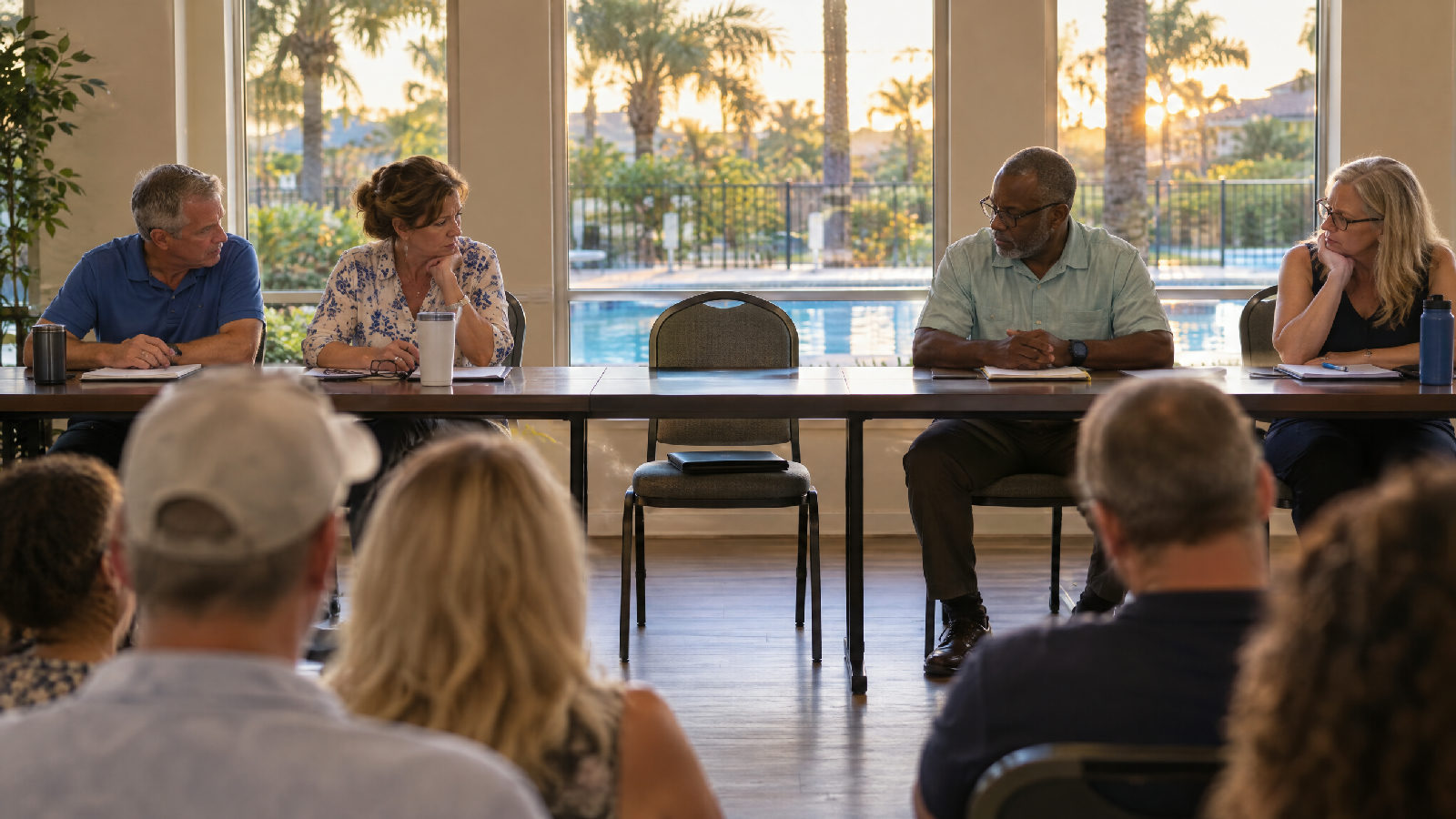
In Florida, a volunteer can be suspended from an HOA board, by statute, for skipping a class. Under § 720.3033, a new director has 90 days to file a certificate of state-approved education; miss it, and they are off the board until they do. Meanwhile, three rules the law never wrote get repeated as if it did: that the board must hire a manager, commission a reserve study and pay for an audit.
Chapter 720, Florida's Homeowners' Association Act, asks for dates, documents and procedures. None of it is a management contract.

The short answer
- Chapter 720 governs a Florida HOA where membership is mandatory and unpaid dues can become a lien on the home.
- The law is mostly deadlines: 90 days to get trained, 48 hours to post a board meeting, 14 days to notice a member meeting, 10 business days to open the records.
- It does not require a manager or name a reserve study, and it requires an audit only at $500,000 in annual revenue or 1,000 parcels.
Last reviewed: October 3, 2026
Which law governs your community
Chapter 720 applies to a Florida corporation that runs a community where membership is mandatory with parcel ownership and unpaid assessments can become a lien (§ 720.301). It does not apply to associations under the condominium, cooperative or timeshare chapters (718, 719 and 721), or to the commercial parcels of a mixed community (§ 720.302). Your own governing documents can add duties on top.
The nine things Chapter 720 actually requires
1. Get trained within 90 days. Every newly elected or appointed director submits a certificate of completing department-approved education within 90 days (§ 720.3033(1)). It is good for up to 4 years. Each director then completes at least 4 hours of continuing education a year (8 hours in an association of 2,500 parcels or more). The association keeps each certificate for members to inspect for 5 years.
2. Hold board meetings in the open, with real notice. Any gathering of a board quorum to do association business is a meeting, and members may attend and speak on every designated agenda item (§ 720.303(2)). Only meetings with the association's attorney about proposed or pending litigation, and meetings on personnel matters, may be closed. Notice names the agenda items and is posted conspicuously at least 48 hours ahead, or mailed or delivered at least 7 days ahead. A meeting that will consider special assessments, or changes to rules on parcel use, needs 14 days' written notice. Directors may talk by email but may not vote by email, by proxy or by secret ballot (except to elect officers). The minutes record each director's vote or abstention on each matter (§ 720.303(3)).

3. Keep the official records, and open them in 10 business days. Official records, including minutes, contracts, the roster and a statement of account for every member, are kept at least 7 years (§ 720.303(4)). Ballots and sign-in sheets are kept at least 1 year. Unless your governing documents provide otherwise, a member's written request gets access within 10 business days, and the member may photograph or scan the records on their own phone at no charge (§ 720.303(5)). An association of 100 or more parcels also posts its core documents, budget, financial report and meeting notices on a website or app with an owners-only section.
$50 a day is the minimum a member can recover for a willful denial of the records, for up to 10 days, starting the 11th business day after the written request. — Fla. Stat. § 720.303(5)(c)
4. Prepare a budget every year, and report the year behind you. The board prepares an annual budget and gives each member a copy, or notice that one is free on request (§ 720.303(6)). Within 90 days after the fiscal year ends (or on the date your bylaws set) it completes a financial report, and gets it, or notice of it, to members within 21 days of completion and no later than 120 days after year end (or the bylaws' date) (§ 720.303(7)). Revenue sets the kind of report:
What the annual report must be, by total annual revenue.
- Under 50,000: A report of cash receipts and expenditures
- 50,000 to $299,999: Compiled financial statements
- $300,000 to $499,999: Reviewed financial statements
- $500,000 or more: Audited financial statements
An association of 1,000 parcels or more is audited whatever its revenue. Members can vote, at a properly called meeting, to prepare a lesser report for a year, but not for consecutive years (§ 720.303(7)(d)).
5. Hold the annual meeting, and run elections the statute's way. Members meet yearly, with notice mailed, delivered or emailed (to owners who consented in writing) at least 14 days before, unless your bylaws set their own notice rule, and an affidavit of that notice filed in the records (§ 720.306(2), (5)). Unless the bylaws set a lower number, quorum is 30 percent of the voting interests. Directors win by plurality unless the documents differ; no election is held when candidates do not outnumber seats. Anyone delinquent to the association when nominations close may not run, and a director more than 90 days delinquent is deemed to have abandoned the seat (§ 720.306(9)).
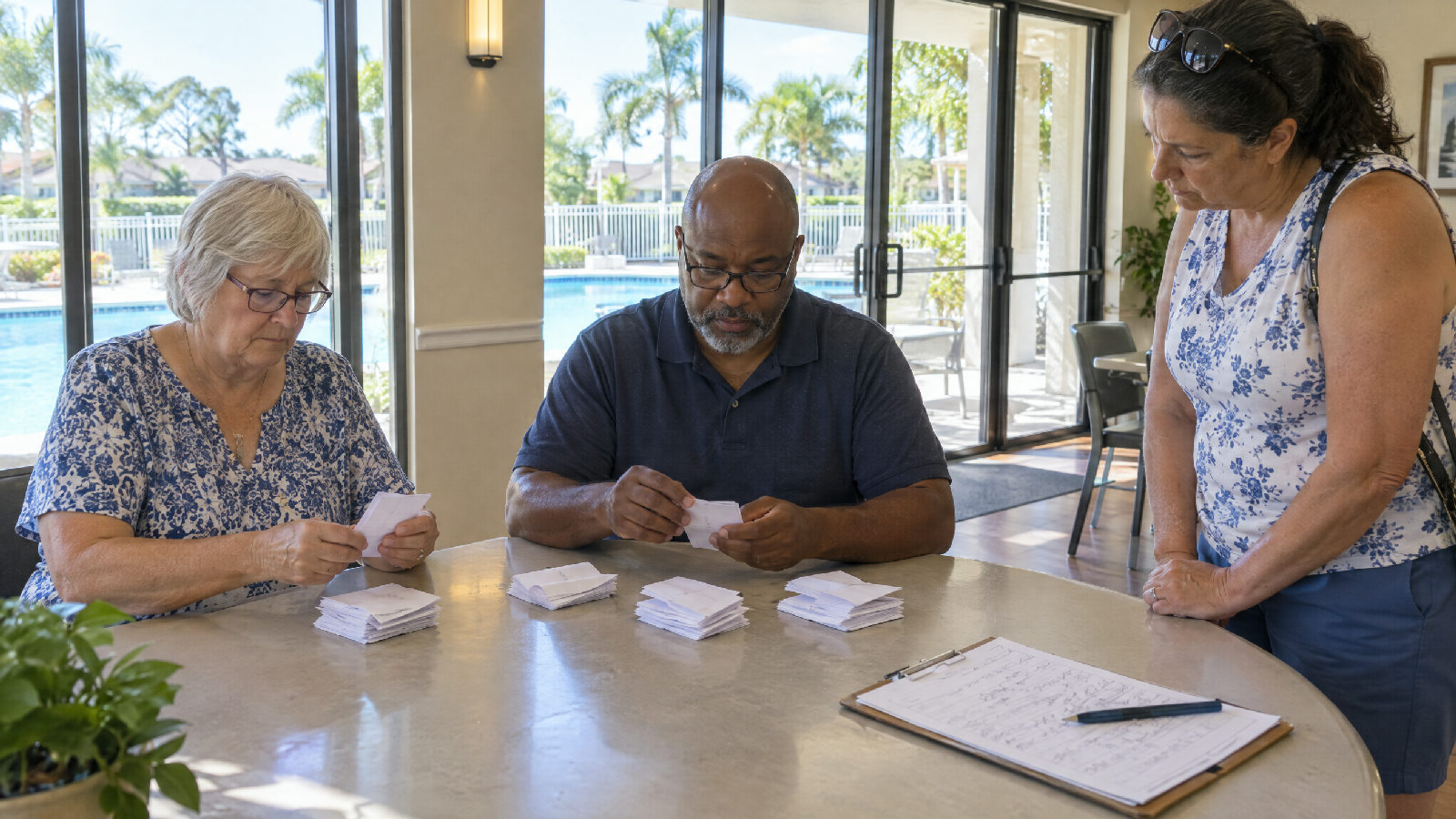
6. Give notice and a hearing before any fine. A fine or suspension needs at least 14 days' written notice of the owner's right to a hearing, held within 90 days before a committee of at least three members who are not officers, directors or employees, or the spouse, parent, child, brother or sister of one (§ 720.305(2)). If the committee does not approve it by majority, or the owner cures the violation first, it cannot be imposed. Unless your documents say otherwise, a fine is capped at
00 per violation and ,000 in total for a continuing one, and a fine under ,000 cannot become a lien. No fine at all for bins left at the curb within 24 hours before or after collection day.7. Collect dues by the statute's ladder. If your documents set no rate, unpaid assessments carry 18 percent simple interest, and a late fee, if your documents allow one, is capped at the greater of $25 or 5 percent of the installment (§ 720.3085(3)–(4)). The lien itself exists only when your governing documents authorize it (§ 720.3085(1)). Each step up the ladder needs its own letter first:
The order Florida law sets for an unpaid assessment.
- Late notice: 30 days before attorney fees
- Intent to lien: 45 days, certified and first-class mail
- Claim of lien: Recorded with the county
- Intent to foreclose: 45 more days before suit
An owner may ask in writing for a detailed accounting of what they owe. The board has 15 business days; miss it, and that owner's fines more than 30 days past due that were never noticed in writing are waived (§ 720.303(14)).
8. Put contracts in writing, bid the big ones, disclose conflicts. Service contracts, and contracts for materials or equipment that run longer than a year, must be in writing. Anything costing more than 10 percent of the annual budget, reserves included, needs competitive bids (§ 720.3055). Contracts with association employees, and for attorney, accountant, architect, community association manager, engineering and landscape architect services, are exempt. A director discloses a possible conflict at least 14 days before the vote, and anyone who signs checks or handles the money is covered by insurance or a fidelity bond unless the members waive it each year (§ 720.3033(5), (6)).
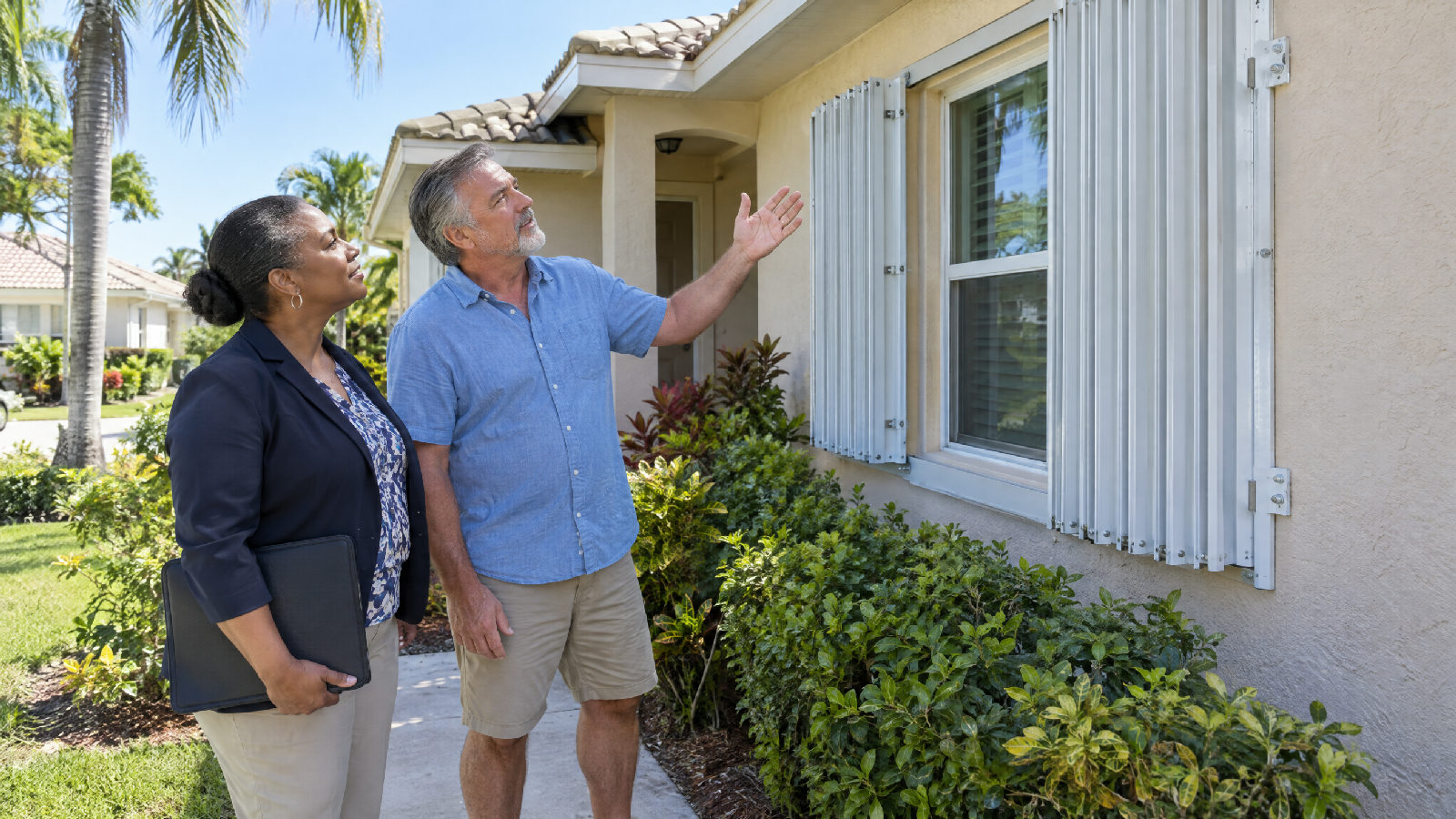
9. Decide architecture by the declaration, and say why in writing. The board or its committee reviews only what the declaration or its authorized guidelines give it authority over, and applies those standards equally to every owner (§ 720.3035(1)). It cannot put requirements on the inside of a home that cannot be seen from the street, a neighboring lot, a common area or a community golf course, or demand a building permit before it will review a plan. It must also adopt hurricane-protection specifications for the homes it governs (§ 720.3035(6)). A denial is written and names the specific rule it rests on (§ 720.3035(4)). A committee that approves or denies plans meets in the open like the board (§ 720.303(2)(a)).
Before you sue, or are sued Covenant-enforcement, board-meeting and records-access disputes between an owner and the association need a demand for presuit mediation before court; collection disputes do not. Election and recall disputes go to state arbitration or to court (§ 720.311).
What the law does not require
- No management company. Chapter 720 mentions a manager only for associations that already have one.
- No reserve study, unless your owners chose reserves. Statutory reserve accounts exist only after a majority of the total voting interests approves them (§ 720.303(6)). Without them, an association that maintains capital improvements prints a statement on its annual financial report that its budget does not provide fully funded reserves. The structural integrity reserve studies in the headlines are condominium law, for buildings three stories or higher (§ 718.112(2)(g)); the phrase does not appear in Chapter 720.
- No audit below $500,000 in revenue and 1,000 parcels. Under 50,000 a year in revenue, the report is cash receipts and expenditures, unless the members vote to raise it.
- No duty to take the lowest bid. The statute says so.
Florida asks a volunteer board for dates, documents and fairness. It does not ask for a payroll.
What this means for a self-led board
Count the numbers in those nine items: 90 days, 48 hours, 7 days, 14 days, 10 business days, 21 days, 120 days, 30 days, 45 days, 15 business days. Florida did not write a law for professionals. It wrote a calendar. Boards get into trouble when the dates live in one volunteer's head, and that volunteer takes a vacation in July.
This week, list every date above, put one director's name beside each, and set a reminder that does not depend on anyone's memory.

The takeaway
Train within 90 days. Post board meetings 48 hours ahead and give 14 days' notice of member meetings. Open the records in 10 business days. Budget every year and report within 90 days of year end, or your bylaws' date. Hear before you fine, and send the letter before you lien. Bid the big contracts and put every denial in writing. A self-led board can run every line of it.
Frequently asked questions
Does Florida require our HOA to fund reserves? Not unless a majority of the total voting interests has voted to provide for them. Once they exist, they are funded every year unless the members vote to waive or reduce them, and that vote covers one budget year only (§ 720.303(6)).
Can our board vote by email? No. Directors may use email to communicate, but they may not cast a vote on an association matter by email (§ 720.303(2)(a)).
Do we need an audit? Audited statements are required at $500,000 or more in annual revenue, or at 1,000 parcels or more. Owners can petition and vote for a higher level, and a majority of the voting interests present at a properly called meeting can vote for a lesser report for one year, but not for consecutive years (§ 720.303(7)).
What Does an HOA Board Actually Have to Do Legally in South Carolina?
This is a plain-language guide, not legal advice. Your governing documents and an attorney licensed in Florida have the final word.
Sources:
- Florida Statutes, Chapter 720 (Homeowners' Associations), 2026 edition: flsenate.gov/Laws/Statutes/2026/Chapter720
- Fla. Stat. § 718.112(2)(g) (condominium structural integrity reserve studies): flsenate.gov