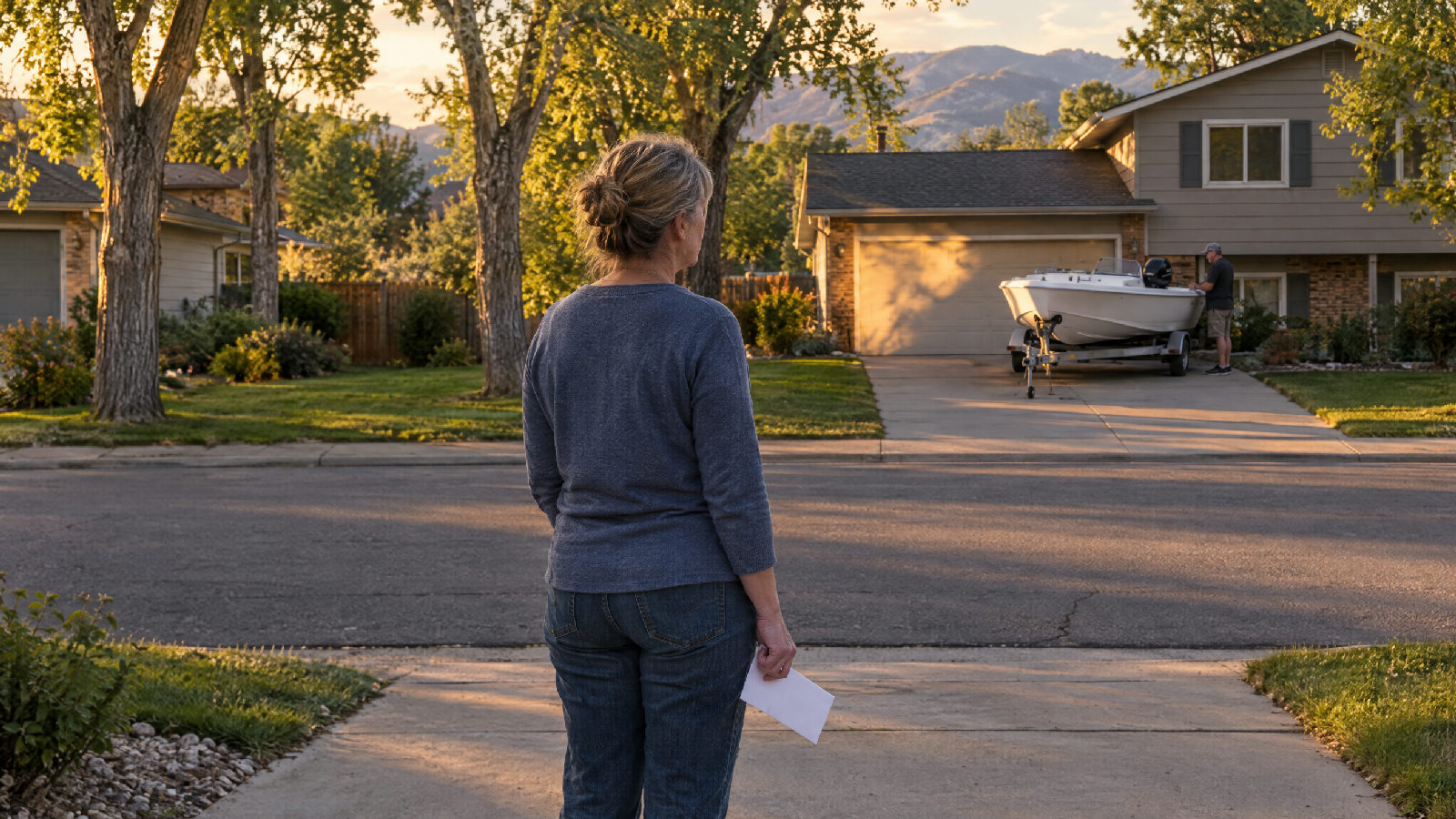
A board member in a Colorado subdivision drafts the letter everyone has wanted sent for a month: the boat trailer in the driveway, $25 a day until it is gone. In Colorado that letter breaks the law three times. The Common Interest Ownership Act bans daily fines, requires 30 days to fix a violation that does not threaten health or safety, and caps the fines for that violation at $500 in total (§ 38-33.3-209.5(1.7)(b)).
Colorado does not leave enforcement to a board's judgement. It writes the letters for you: who gets them, by what mail, and in what order.

The short answer
- A Colorado HOA board has to register every year, meet in the open, publish an annual disclosure, keep nine written policies, and follow the statute's ladder before any fine, lawyer or lien.
- The Colorado Common Interest Ownership Act (C.R.S. Title 38, Article 33.3) sets those duties for every HOA created on or after July 1, 1992, except very small ones, and its core duties reach older communities too.
- It does not require a manager or a reserve study, and it requires an audit only when yearly revenue or spending reaches $250,000 and owners of a third of the units ask for one.
Last reviewed: October 5, 2026
Which law governs your community
The Act applies in full to every common interest community created in Colorado on or after July 1, 1992 (§ 38-33.3-115). An older community is covered by the sections listed in § 38-33.3-117, which include most of what follows, though an older declaration's express terms still win on some of them (§ 38-33.3-117(2)).
Small communities sit almost entirely outside the Act. A planned community created since July 1, 1992 with no more than 20 units and no development rights, or whose declaration caps each home's average yearly common expenses at $400 (adjusted for inflation), is subject only to §§ 38-33.3-105 to 107 unless its declaration opts in (§ 38-33.3-116). For an older community the line is 10 units, or the same cap (§ 38-33.3-119).
This page reads the 2024 Colorado Revised Statutes with two later acts that changed some of these sections: HB25-1043, in force October 1, 2025, and HB26-1099, in force August 12, 2026.
The ten things the Act actually requires
1. Register with the state, every year. Every association registers annually with the Division of Real Estate; one with revenue of $5,000 or less pays no fee (§ 38-33.3-401). What few boards know: while the registration has lapsed, the association's right to impose or enforce a lien for assessments, and its enforcement remedies under § 38-33.3-123, are suspended. Since HB25-1043, the registration also reports, for the past 12 months, how many owners were six or more months behind and how many payment plans, judgments and foreclosure actions the association had.
2. Hold board meetings in the open, and let owners speak before you vote. Every board and committee meeting is open to every owner, and agendas are made reasonably available (§ 38-33.3-308). Before the board votes on an issue, owners may speak on it, within reasonable time limits. A closed session is allowed for six kinds of matter only, among them personnel, legal advice, and an owner's privacy in a disciplinary hearing or delinquency referral. The chair announces its subject first, and no rule may be adopted behind closed doors.

3. Meet the owners once a year, with real notice. The owners meet at least once a year (§ 38-33.3-308(1)). Notice goes out 10 to 50 days before, by hand or prepaid mail, and by email to owners who ask for it, with the time, place and agenda. Owners with 20 percent of the votes can call a special meeting. In a community created since July 1, 1992, unless the bylaws say otherwise, 20 percent of the votes is a quorum, 10 percent in an association with more than 1,000 owners (§ 38-33.3-309).
4. Send the budget out, and let the owners veto it. Within 90 days after adopting a proposed budget, the board sends a summary to every owner and sets a meeting to consider it (§ 38-33.3-303(4)(a)). Unless the declaration requires otherwise, the budget stands unless a majority of all owners, not just those present, vetoes it at that meeting.
5. Put nine policies in writing. The association adopts written policies on nine subjects (§ 38-33.3-209.5(1)):
- collecting unpaid assessments;
- board members' conflicts of interest, including disclosure and when a director recuses;
- how meetings are run;
- enforcing covenants and rules, with notice, a hearing and the schedule of fines;
- inspecting and copying records;
- investing reserve funds;
- adopting and amending policies;
- resolving disputes between the association and owners;
- reserve studies: whether one exists, whether a funding plan backs it, and whether it rests on a physical and a financial analysis. A study done in-house is enough.
Since HB25-1043 the association also asks each owner, from time to time, for a phone number, a cell number for texts and an email address.
6. Publish the annual disclosure, and teach the owners once a year. Within 90 days after each fiscal year ends, the association makes available to owners, free: its budget and assessments, last year's financial statements including reserves, the latest audit or review, its insurance policies, its bylaws, articles and rules, last year's minutes, and its governance policies (§ 38-33.3-209.4(2)). Separately, it gives owners free education at least once a year on how it operates and on owners' and the board's rights and duties (§ 38-33.3-209.7).
New for new communities Since August 12, 2026, a developer must commission and pay for a reserve study projecting 30 years of costs before handing control to the owners, and the association's annual disclosure includes it (HB26-1099, § 38-33.3-209.2).
7. Produce the records, and the balance letter, on time. An owner may examine and copy the records the statute lists, among them all minutes, three years of financial statements and seven years of tax returns (§ 38-33.3-317). The association may ask for a written request 10 days ahead, but may not ask why, and it must withhold personnel records and owners' phone numbers, email addresses and bank details. If it has not allowed inspection within 30 calendar days of a certified-mail request, it owes $50 a day from the 11th business day, up to $500 or the owner's actual damages, whichever is greater. And a written statement of an owner's unpaid assessments goes out within 14 calendar days of a written request delivered by hand or certified mail; if it does not, the association loses its lien for what was due on the date of the request (§ 38-33.3-316(8)).

8. Fine by the statute's clock. No fine without a written fine policy that gives the owner notice and a chance to be heard before an impartial decision maker (§ 38-33.3-209.5(2)). No daily fines, and no daily late fees. Then the violation decides the clock (§ 38-33.3-209.5(1.7)(b)):
Two clocks, depending on the violation.
- Health or safety: Written notice, 72 hours to cure
- Then: Fines no more often than every other day
- Anything else: Certified letter, 30 days to cure
- Then: Fines capped at $500 for that violation
- Before suing: Two 30-day cure periods, for anything but health or safety
An owner who cures can send photos, and the violation counts as cured the day they send them; if the owner sends no word, the association inspects within 7 days after the cure period ends. Once it is cured, the association tells the owner the fines have stopped and what is left to pay. Every notice goes in English and in any language the owner has asked for. And the association cannot foreclose on a lien made up only of fines and the costs of collecting them (§ 38-33.3-209.5(8)(c)).

9. Collect dues by the ladder, and vote before any lawyer. The association adopts a written collection policy before it uses a collection agency or a lawsuit (§ 38-33.3-209.5(5)), and the steps run like this:
The steps Colorado sets before a foreclosure.
- First contact: Certified letter plus two other ways
- The vote: A recorded board majority to refer
- The offer: An 18-month payment plan, in writing
- The threshold: Six months of assessments owed
- The notices: 30 days before filing
First, the association sends a notice of delinquency by certified mail and reaches the owner two other ways: a call (with a voicemail), a text or an email the owner gave, or regular mail if they gave none (§ 38-33.3-209.5(1.7)(a), as amended by HB25-1043). The notice states what is owed, says whether a payment plan is available, names who sends a copy of the ledger (within 7 business days of a request), and warns that unpaid assessments can end in a sale at auction. An account goes to a collection agency or lawyer only on a majority vote of the board, recorded at a meeting; a manager cannot send it alone. Interest is capped at 8 percent a year (§ 38-33.3-209.5(8)), payments go to assessments before fines (§ 38-33.3-316.3(4)), and every owner with a balance gets an itemized list each month (§ 38-33.3-209.5(1.7)(c)).
Before a foreclosure lawsuit, the owner must have been offered in writing 18 monthly payments of at least $25, and then not accepted within 30 days or missed at least three payments by more than 15 days (§ 38-33.3-209.5(7)). The balance must reach six months of assessments, and the board itself must vote on the record to foreclose on that home (§ 38-33.3-316(11)). For an owner who lives in the home, the association first needs a personal judgment, except in the narrow cases the statute lists (§ 38-33.3-316(10.5)).

At least 30 days before filing, the owner gets written and electronic notice of the right to mediation (§ 38-33.3-316(10.7)) and of the right to credit counseling, and a notice of intent to foreclose by certified mail and two other ways (HB25-1043, § 38-33.3-316(10.3) and (10.8)). Attorney fees the association can recover are capped at $5,000 or half of what is owed, whichever is less (adjusted for inflation each year); a court may award more only if it finds the owner was able to comply and willfully did not (§ 38-33.3-123(1)).
10. Elect by secret ballot, and let the owners remove you. Contested board seats are decided by secret ballot, counted by a neutral third party or by owner volunteers who are not candidates or directors (§ 38-33.3-310(1)(b)). The board cannot elect its own members, though it can fill a vacancy for the rest of the term (§ 38-33.3-303(3)). In a community created since July 1, 1992, owners can remove a director, with or without cause, by 67 percent of those present and entitled to vote at a meeting with a quorum (§ 38-33.3-303(8)).
What the law will not let a board ban
Whatever the declaration says, an association cannot prohibit (§ 38-33.3-106.5):
- A flag on the owner's property, in a window or on a balcony, or a flagpole. It can set content-neutral rules on number, size and location, and it can ban commercial flags.
- A sign in the owner's window or yard, on the same terms.
- Clearing brush for fire defense under a written defensible-space plan from the state forest service or the local fire authority, registered with the association first.
- Reasonable modifications a person with a disability needs under the federal Fair Housing Act.

What the law does not require
- No management company. The Act's rules for a managing agent, such as a fidelity bond, apply only if a board hands one the association's money (§ 38-33.3-306(3)); HB26-1099 even names "a self-managed association" in the statute (§ 38-33.3-317(9)).
- No reserve study. Only a written policy saying whether you have one (§ 38-33.3-209.5(1)(b)(IX)). Your declaration may still require one.
- No yearly audit. An audit is required only when annual revenue or spending is at least $250,000 and owners of a third of the units ask; owners of a third of the units can ask for a less formal review at any size (§ 38-33.3-303(4)(b)).
Colorado does not ask a volunteer board to hire anyone. It asks the board to send the right letter, in the right order, and to vote where the owners can see it.
What this means for a self-led board
Most of the Act is a sequence: a letter, a wait, a vote, another letter. Being right about the violation is not enough. Since HB25-1043, a court that finds the association out of strict compliance with the lien and foreclosure rules can pause the case until it complies, with no late fees or interest running (§ 38-33.3-123(3), HB25-1043).
Four things to do this week:
- Look up your association's registration with the Division of Real Estate and check that it has not lapsed.
- Pull your fine letter template and strike any daily fine, any cure period shorter than 30 days for a non-safety violation, and any total over $500.
- Find your nine written policies. If one is missing, put its adoption on the next meeting's agenda.
- Put any delinquent account headed to a lawyer on the next agenda for a recorded board vote.

The takeaway
Colorado lets a volunteer board run its community without a manager. In return it wants the community registered, the meetings open, nine policies in writing, and every fine and collection step taken in order. Keep that paper trail and the law is on your side.
Frequently asked questions
Can a Colorado HOA fine a homeowner every day? No. Daily fines and daily late fees are banned. For a violation that does not threaten health or safety, the owner gets 30 days to cure, and fines cannot total more than $500 (§ 38-33.3-209.5(1.7)(b)).
Can our manager send a delinquent account to the HOA's lawyer? Not alone. A majority of the board must vote to refer it, in a recorded vote at a meeting (§ 38-33.3-209.5(1.7)(a)(II)).
Does Colorado require an HOA to have a reserve study? No, only a written policy on whether you have one, and an in-house study counts. Since August 12, 2026, a developer must pay for one before handing a new community to its owners.
What Does an HOA Board Actually Have to Do Legally in Arizona?
This is a plain-language guide, not legal advice. Your governing documents and an attorney licensed in Colorado have the final word.
Sources:
- Colorado Common Interest Ownership Act, C.R.S. Title 38, Article 33.3, as published in the 2024 Colorado Revised Statutes by the Colorado General Assembly: Title 38 (PDF)
- House Bill 25-1043, signed June 4, 2025, effective October 1, 2025: leg.colorado.gov
- House Bill 26-1099, signed April 13, 2026, effective August 12, 2026: leg.colorado.gov