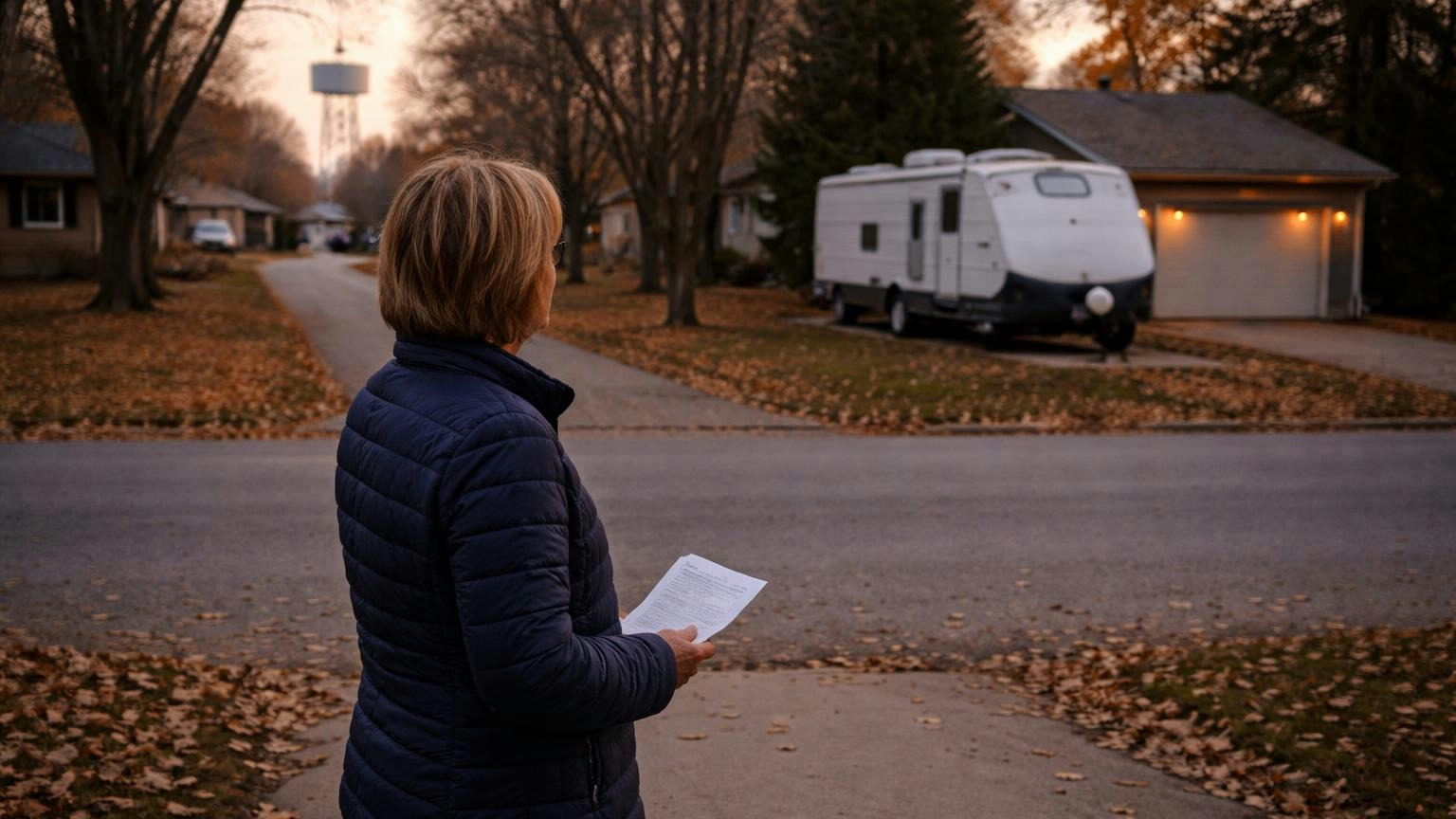
Picture this letter reaching the board president of a 90-home subdivision outside Ankeny. An owner has parked a camper beside his driveway, and the board has written to him twice about the covenant against it. Now he writes back. The covenants were recorded in 1999, he says, more than 21 years ago. Show me the claim you filed with the county recorder.
He is pointing at a real statute. Under Iowa Code § 614.24, no court action on a recorded use restriction, parking and storing recreational vehicles included, can be maintained against the owner in possession more than 21 years after the instrument was recorded, unless a verified claim was filed with the county recorder within that time. Whether he is right about this declaration depends on what was recorded, when, and whether anyone ever filed. That is a question for an Iowa attorney. Most boards would not know to ask it, and nothing in the statute sends a reminder.
Iowa also has no single HOA act, so a board's duties are spread across several chapters of the Iowa Code. Here is what those chapters ask of a board, each duty tied to its section.
The short answer
- Iowa has no single HOA act. A board's duties come from Chapter 499C (records, since 2023), the Revised Iowa Nonprofit Corporation Act (Chapter 504) if the association is incorporated, and the Horizontal Property Act (Chapter 499B) if it is a condominium.
- Every association covered by Chapter 499C must hand an owner its governing documents, rules and latest minutes within ten business days of a request, for a fee no higher than the cost of producing them. An incorporated association must also hold an annual meeting with a financial report, give members fair notice (10 to 60 days ahead is the window the statute accepts), and keep its minutes permanently.
- The Iowa trap: under § 614.24, no court action on a recorded use restriction can be maintained against the owner in possession more than 21 years after it was recorded, unless a verified claim was filed with the county recorder within that time. Each filing extends the time another 21 years (§ 614.25).
Last reviewed: November 12, 2026

Which laws govern, and how to tell which reach you
Three chapters set the duties, and each reaches a different kind of association. A fourth section, § 614.24, puts a clock on the covenants themselves (requirement 10 below).
- Chapter 499C, for every common interest community. Added in 2023, Chapter 499C is short: two sections, one about records. Its reach is wide. A "common interest community" is real estate described in a declaration where owning a unit obliges the owner to pay a share of taxes, insurance, maintenance or other costs of common elements or other property. A "planned community," the statute says, "includes property owner or homeowner associations" (§ 499C.1(7)).
- Chapter 504, if the association is incorporated. Many Iowa associations are nonprofit corporations, and the Revised Iowa Nonprofit Corporation Act sets their meetings, notice, records and annual filing.
- Chapter 499B, if it is a condominium. The Horizontal Property Act governs a condominium regime and adds open board meetings and a lien for unpaid assessments.
Chapter 499C does not reach three arrangements (§ 499C.1(3)(b)):
- A shared wall, driveway or well. A covenant that only splits the cost of one shared structure is not a common interest community, unless every owner agrees in writing to make it one.
- One owner. Real estate where a single owner holds every unit.
- The developer's community. Real estate still managed by the original developer.
What the law requires
1. Hand over five sets of records within ten business days. When an owner or the owner's authorized agent asks, the association, its designee or its management company must make these available within ten business days (§ 499C.2(1)):
- the organizational documents for the community, with all amendments;
- the bylaws, with all amendments;
- the rules, with all amendments;
- the minutes of the most recent owners' meeting, with any financial reports;
- the minutes of the most recent board meeting, with any financial reports.
10 business days is how long an Iowa HOA, its designee or its management company has to produce its governing documents, rules and latest minutes for an owner who asks. — Iowa Code § 499C.2(1)
The minutes themselves have a required shape. Each set "must indicate the date, time, and place of the meeting, the names of all persons present at the meeting, each action taken at the meeting, and the results of each vote taken at the meeting" (§ 499C.2(1)(d), (e)).

2. Deliver them on paper, by email or on a website, and charge only the cost. The association may provide the records as a paper copy, by email to an address the owner gives, or by posting them to a website the owner can reasonably reach (§ 499C.2(2)). It may charge "a reasonable fee," but the fee "shall not exceed the estimated cost of production or reproduction" (§ 499C.2(3)).
HOA Records Request: What the Board Must Hand Over, and When

3. Hold an annual meeting, with a report on the money. An incorporated association with members must hold a membership meeting every year, at a time set in or under its bylaws (§ 504.701(1)). At that meeting, "the president and chief financial officer shall report on the activities and financial condition of the corporation" (§ 504.701(4)(a)). The board may hold it entirely by remote communication, and the notice then says how members take part (§ 504.701(3A)). Missing the date does not undo what the association has done in the meantime (§ 504.701(6)), but the duty stays.
If the meeting slips If no annual meeting is held within six months after the fiscal year ends or 15 months after the last one, whichever comes first, any member may ask the district court to order one. The court may make the association pay that member's costs and attorney fees (§ 504.703(1)(a), (3)).
Get Quorum at Your HOA Annual Meeting: A 2-Week Plan

4. Give notice in the 10-to-60-day window. The rule is that notice of members' meetings be fair and reasonable and consistent with the bylaws (§ 504.705(1)). The statute names one way that always qualifies: notice of the place, date and time of an annual, regular or special members' meeting that goes out no more than 60 days and no fewer than 10 days ahead, or at least 30 days ahead if it is mailed by anything other than first-class or registered mail (§ 504.705(3)(a)). A special meeting's notice must describe what the meeting is called for (§ 504.705(3)(c)), and only those matters may be taken up (§ 504.702(5)). If someone entitled to call a special meeting asks in writing, at least ten days before the notice goes out, to raise a matter, the notice must include it (§ 504.705(5)).
10 to 60 days before an Iowa nonprofit association's members' meeting is the window for fair and reasonable notice (at least 30 days if mailed other than first-class or registered). — Iowa Code § 504.705(3)(a)
HOA Notice Requirements: What You Owe and How to Prove It
5. Call a special meeting when five percent of the members demand it. Unless the articles or bylaws say otherwise, holders of at least 5% of the voting power can sign and deliver a written demand for a special meeting that describes its purpose (§ 504.702(1)(b)). If notice of that meeting is not given within 30 days of the demand, a person who signed it may set the time and place and give the notice themselves (§ 504.702(3)).

6. Act between meetings only on a unanimous signed consent. The board may act without a meeting only if every director signs a consent describing the action and delivers it to the association (§ 504.822(1)), unless the articles or bylaws require a meeting. Regular board meetings need no notice unless the articles or bylaws say otherwise; a special board meeting needs at least two days' notice to each director of the date, time and place (§ 504.823(1), (2)).
Can an HOA Board Vote by Email? Only If Every Director Signs
7. Keep minutes permanently, and keep three years of the rest. An incorporated association keeps "as permanent records minutes of all meetings of its members and board of directors," along with a record of actions taken without a meeting (§ 504.1601(1)). It keeps appropriate accounting records and a list of members with addresses and votes (§ 504.1601(2), (3)). It also keeps copies of its articles and bylaws, the members' minutes for the past three years, all written communications to members for the past three years, a list of current directors and officers, and its most recent biennial report (§ 504.1601(5)).

8. Let members inspect on the statute's clock. A member who gives written notice at least five business days ahead may inspect and copy the records listed in § 504.1601(5) (§ 504.1602(1)). For the accounting records, the membership list and excerpts of other minutes, the member gives ten business days' written notice and must ask in good faith, for a proper purpose described with reasonable particularity, for records directly connected to it (§ 504.1602(2), (3)). Copies may carry a charge covering labor and materials, no higher than the cost of producing them (§ 504.1603(3)). On written demand, the association furnishes its latest annual financial statements, including a balance sheet and a statement of operations (§ 504.1611(1)).
It shall also order the corporation to pay the member's costs, including reasonable attorney fees incurred, to obtain the order. — Iowa Code § 504.1604(3)
That sentence is why a refused records request is expensive. If a court orders inspection, the association pays the member's costs and attorney fees, unless it proves it refused in good faith with a reasonable basis to doubt the member's right (§ 504.1604(3)).
9. File the biennial report between January 1 and April 1 of odd years. Every Iowa nonprofit corporation delivers a biennial report to the Secretary of State: its registered office and agent, its principal office, the names and addresses of the president, secretary, treasurer and one director, and whether it has members (§ 504.1613(1)). After the first, reports are due between January 1 and April 1 of each odd-numbered year (§ 504.1613(3)). The next window opens January 1, 2027. A missed report is not a paperwork nuisance: if it has not arrived within 60 days after it is due, the Secretary of State may begin administratively dissolving the corporation (§ 504.1421(1)).

10. Renew the covenants before 21 years run out. Under § 614.24(1), no action based on a use restriction in a recorded deed, conveyance or contract may be maintained against the record owner in possession more than 21 years after it was recorded, unless the person claiming the restriction files a verified claim with the recorder of the county where the land sits within that 21-year period. The claimant can be "any member of a class of persons entitled to or claiming such rights." Filing extends the time "for a further period of twenty-one years," and further claims may be filed for further extensions (§ 614.25).
The statute names what counts. A "use restriction" includes limits on commercial uses, rental use, parking and storing recreational vehicles, pets, outdoor domestic uses, accessory structures, building dimensions and colors, building materials and landscaping (§ 614.24(5)).
How an Iowa use restriction runs out.
- Year 0: The covenants are recorded
- Year 21: The window to file a verified claim closes
- After: A court will not enforce the restriction against the owner in possession
Three things are carved out:
- Cost sharing is not a use restriction. An agreement to share taxes, insurance, maintenance, repairs or other costs related to two or more parcels, and an agreement to share and maintain driveways, roads or common areas, are excluded from the definition (§ 614.24(5)(b), (c)).
- Easements are not either. An easement for access, utilities, parking areas or solar access is excluded (§ 614.24(5)(a)).
- Condominium documents stand. A condominium's declaration, articles, bylaws and rules stay in force as long as the regime exists, and § 614.24 does not extinguish them (§ 499B.21).
Chapter 499C points at the same rule. In a community of fewer than 1,000 units, a "rule" does not include "a restrictive covenant that has expired" (§ 499C.1(8)).
11. In a condominium, open the board's meetings and give seven days' notice. A condominium's bylaws must say how it is run. If a board runs it, board meetings "must be open to all apartment owners," except meetings with the board's attorney about proposed or pending litigation that attorney-client privilege would cover (§ 499B.15(2)). Notice of each board meeting must be mailed or delivered to every owner at least seven days ahead. Minutes are kept in writing, or in a form that can be put in writing within a reasonable time, and the board's official records are open to inspection and copying at reasonable times and places. An action taken at a meeting that breaks these rules "is not valid or enforceable."
7 days is the notice every owner in an Iowa condominium run by a board must get before each board meeting. — Iowa Code § 499B.15(2)
12. In a condominium, collect through the lien the statute gives. Unpaid assessments are a lien on the unit, ahead of every lien except tax liens and the first mortgage of record (§ 499B.17). The association may foreclose it like a mortgage, or sue for a money judgment without foreclosing. A first mortgage lender that takes the unit by foreclosure does not owe the assessments that fell due before it took title; those become a common expense of all owners (§ 499B.18). In an ordinary sale, the buyer is liable jointly with the seller for unpaid assessments, but is entitled to a statement of the amount and is not liable beyond it (§ 499B.19).
When a Home Sells, Six HOA Records Change by Hand

What the law does not require
These points are limited to the law read for this page: chapters 499C and 499B, the sections of chapter 504 cited above, and §§ 614.24 and 614.25. Your documents, and other laws, may add more.
- A reserve study or a reserve contribution. None of these chapters requires one.
- An owner vote on the budget. None of them sets one; your declaration or bylaws may.
- A statewide fining procedure. None of these chapters sets steps before a fine. Your declaration and bylaws decide whether the board may fine and how.
- Open board meetings outside a condominium. The open-meeting and seven-day notice rules of § 499B.15(2) are written for a condominium's board. Chapter 504 lets regular board meetings go without notice unless the articles or bylaws require it (§ 504.823(1)).
- Mediation before a lawsuit. None of these chapters requires it.
On accessory dwelling units, Iowa's rules for cities and counties leave a community's rules in place: an ADU may be limited by "a rule of a common interest community," and a city may not regulate ADUs more strictly in a common interest community than at a single-family home (§ 364.3(23); for counties, § 331.301).
What this means for a self-led board
Most of Iowa's law is a calendar and a file cabinet. Put three dates on the calendar: the annual meeting with its notice window, the biennial report window in odd years, and the 21st anniversary of the recording of your declaration. Then keep the file cabinet ready to answer any owner in ten business days: the declaration and every amendment, the bylaws, the rules, and the last owners' and board minutes with their financial reports.
The covenant date is the one that may not be fixable later. This month, pull the recording dates of your declaration and of every amendment from the county recorder, and ask whether a verified claim was ever filed. Take that list to an Iowa attorney with two questions: which date starts the 21 years for each restriction, and, if a window has already passed with no claim on file, what the association can still enforce. If a window is still open, ask how to file before it closes.
HOA Collection Policy: Seven Decisions Before Anyone Is Late
Frequently asked questions
Do Iowa HOA covenants expire after 21 years? A use restriction cannot be enforced in court against the record owner in possession more than 21 years after it was recorded, unless a verified claim was filed with the county recorder within that period (Iowa Code § 614.24(1)). Each claim extends the time another 21 years (§ 614.25). Cost-sharing agreements, easements and condominium documents are carved out (§ 614.24(5); § 499B.21). How it applies to a given declaration is a question for an Iowa attorney.
How long does an Iowa HOA have to give me its records? Ten business days from your request for the governing documents, bylaws, rules and the most recent owners' and board minutes with their financial reports (Iowa Code § 499C.2(1)). The fee may not exceed the cost of producing them (§ 499C.2(3)).
Do Iowa HOA board meetings have to be open to owners? In a condominium, yes: board meetings are open to all owners, with seven days' notice, except attorney meetings about litigation (Iowa Code § 499B.15(2)). For other associations, the chapters this page covers set no open-meeting rule; check your bylaws.
What happens if our association misses the biennial report? The report is due between January 1 and April 1 of each odd-numbered year (Iowa Code § 504.1613(3)). If it has not been delivered within 60 days after it is due, the Secretary of State may start administrative dissolution of the corporation (§ 504.1421(1)). File early; the next window opens January 1, 2027.
This is a plain-language guide, not legal advice. Your governing documents and an attorney licensed in Iowa have the final word.
Sources:
- Iowa Code 2026, as published by the Iowa Legislature at legis.iowa.gov: Chapter 499C (§§ 499C.1, 499C.2); Chapter 499B, the Horizontal Property Act (§§ 499B.15, 499B.17, 499B.18, 499B.19, 499B.21); §§ 614.24 and 614.25; and Chapter 504, the Revised Iowa Nonprofit Corporation Act (§§ 504.701, 504.702, 504.703, 504.705, 504.822, 504.823, 504.1601, 504.1602, 504.1603, 504.1604, 504.1611, 504.1613, 504.1421), each linked where it is cited above.
- Iowa Code §§ 364.3 and 331.301 on accessory dwelling units.