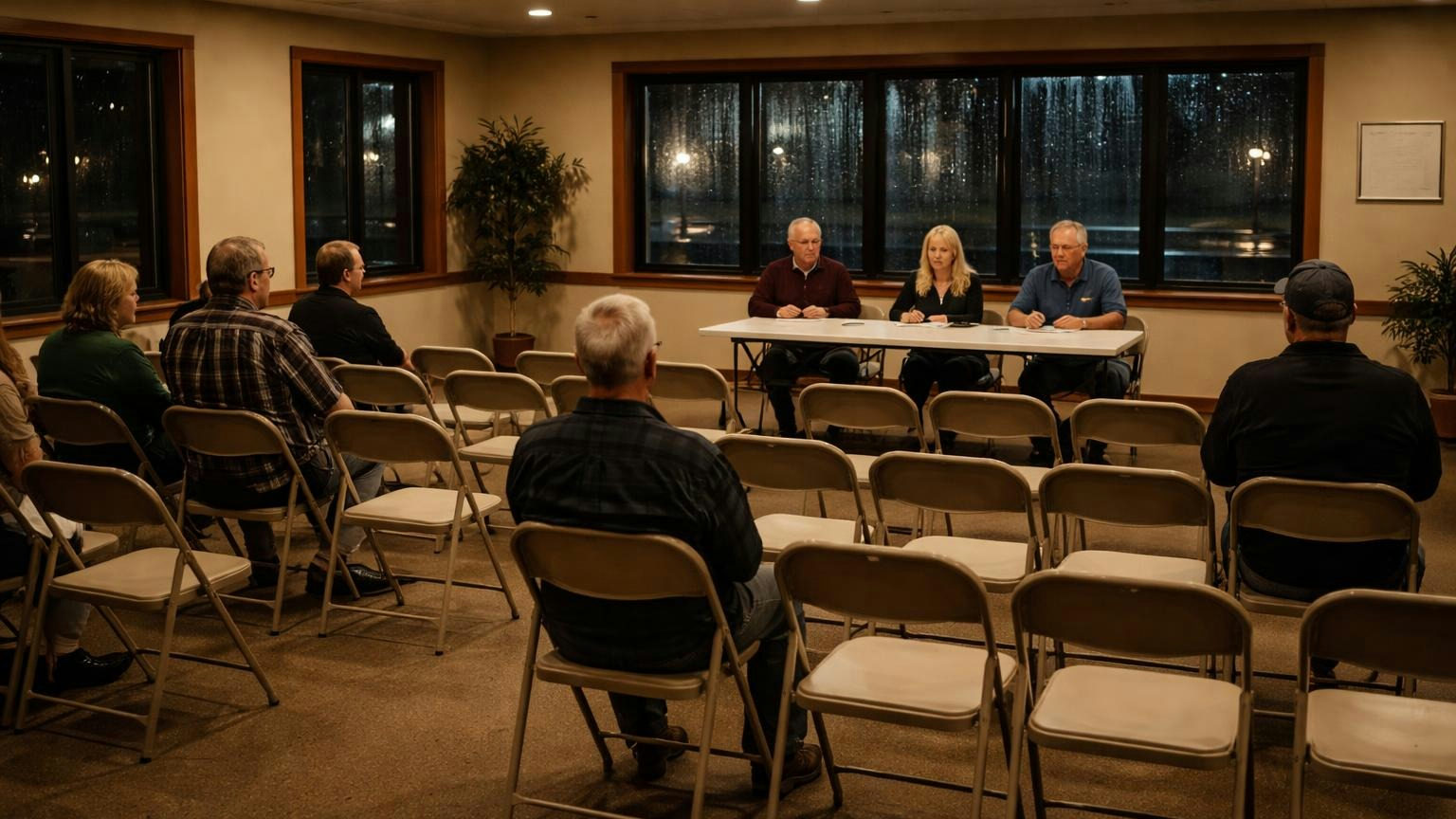
Picture a 36-unit condominium outside Portland. The treasurer has the new budget ready, and the president has bad news: last year's budget meeting drew nine owners, and he is sure the bylaws need a quorum to pass anything. "If we can't get people in the room," he says, "we're stuck on last year's numbers."
Under the Maine Condominium Act, he has it backwards. The board sends every owner a summary of the budget within 30 days of adopting it and sets a meeting 10 to 30 days after mailing it. At that meeting the budget is ratified unless a majority of all the unit owners reject it, "whether or not a quorum is present." Even an empty room ratifies the budget.
That is Maine in one example. The state has a detailed act for condominiums and no act at all for a subdivision homeowners' association, which answers instead to Maine's general nonprofit corporation law and its own documents. One rule, on solar panels and clotheslines, reaches every kind of association whose rules were adopted after September 30, 2009. Here are 22 duties, each tied to its section on the Maine Legislature's site.
The short answer
- What a Maine HOA board must legally do depends on what the community is, because Maine has no single HOA act. A condominium created after January 1, 1983 follows the Maine Condominium Act, 33 M.R.S. §1601-101 and following; older condominiums follow the Unit Ownership Act plus a listed part of the newer act. A homeowners' association incorporated as a nonprofit follows the Maine Nonprofit Corporation Act, Title 13-B, and its own documents.
- A condominium board must hold an owners' meeting every year with 10 to 60 days' notice and the agenda, let owners attend board meetings, send owners a budget summary within 30 days and call a ratification meeting. It must also keep eleven kinds of records open on 10 days' written notice, and give notice and a chance to be heard before any fine.
- An incorporated HOA must hold an annual meeting, give members 10 to 50 days' written notice unless its articles or bylaws say otherwise, keep books, minutes and a member list open to a voting member, for a proper purpose, on 5 business days' written notice, and file an annual report with the Secretary of State.
Last reviewed: November 24, 2026

Which law governs: the Condominium Act, the Nonprofit Corporation Act, or your documents
Maine does not have one statute for every association. Three sets of rules reach different boards.
- A condominium created after January 1, 1983. The Maine Condominium Act applies to every condominium created under it in Maine, and to an older one that amends its documents to come under it (33 M.R.S. §1601-102(a)). The Act took effect on that date (§1601-116).
- An older condominium. It stays under the Unit Ownership Act, 33 M.R.S. §560 to §587, but a listed set of the newer Act's sections reaches it for events after January 1, 1983: among them the association's powers, the lien for assessments, association records and resales (§1601-102(a)). This page marks those duties.
- A subdivision homeowners' association. No Maine statute governs it as an HOA. If it is incorporated, the Maine Nonprofit Corporation Act, Title 13-B, sets its default rules on meetings, voting, records and directors; its declaration, bylaws and articles fill in the rest. A condominium association must itself be organized as a Title 13-B nonprofit corporation (§1603-101), so those rules reach condominiums too, wherever the Condominium Act is silent.
Start with your declaration. If it gives owners undivided interests in common elements, you are a condominium; its recording date tells you which act.

Step one: What the Condominium Act requires of a condominium board
1. Hold an owners' meeting every year, with notice of the agenda. The association meets at least once a year. The bylaws name the officer who sends notice to each unit owner 10 to 60 days before any meeting, by hand, prepaid mail, or electronic means to an address the owner designates. The notice states the time, place and agenda items, including the general nature of any proposed amendment to the declaration or bylaws, any budget changes and any proposal to remove a director or officer (33 M.R.S. §1603-108).
10 to 60 days is the window for notice of a Maine condominium owners' meeting, and the notice must list the agenda. — 33 M.R.S. §1603-108
2. Let owners attend board meetings, and vote only in the open. The board gives timely notice, reasonably calculated to inform owners, of the date, time, place and topics of its meetings; posting in a prominent place in the common elements or email will do, and actual notice to each owner is not required. Owners have the right to attend, subject to reasonable rules the board sets. The board may close an executive session only to consult its attorney, discuss litigation or other proceedings, discuss labor or personnel matters, discuss contracts being negotiated where early public knowledge would disadvantage the association, or protect someone's privacy. A final vote or action may not be taken in executive session (§1603-108).

3. Count the quorum the Act's way. Unless the bylaws say otherwise, an owners' meeting has a quorum if persons entitled to cast 20 percent of the votes for the board are present in person or by proxy at the start, and the quorum then counts for the whole meeting. The bylaws may set a larger percentage, or a smaller one of not less than 10 percent. A board meeting has a quorum when 50 percent of the board's votes are present at the start, unless the bylaws require more (§1603-109).
4. Treat proxies the way the Act does. A proxy must be dated and may not claim to be revocable without notice; otherwise it is void. An owner revokes one only by actual notice to the person presiding, and it ends 11 months after its date unless it says sooner. No votes may be cast for a unit the association owns (§1603-110).
5. Send the budget summary, and let the ratification rule work. Within 30 days of adopting a proposed budget, the board provides a summary to all unit owners and sets a meeting to consider ratification 10 to 30 days after mailing it. Unless a majority of all the unit owners, or a larger vote the declaration sets, reject it at that meeting, the budget is ratified, whether or not a quorum is present. If it is rejected, the last ratified budget continues until the owners ratify a new one (§1603-103(c)). Once the association has started assessing, it assesses at least annually on a budget adopted at least annually (§1603-115(a)).
HOA Budget Variance: Three Questions Before You Raise Dues

6. Ratify a special assessment, unless it is a small emergency. A special assessment goes through the same ratification as the budget; if any part of it is due after the current budget year ends, it needs the approval of a majority in interest of all unit owners. If the assessment is no more than 2 months' common charges and the board determines it is needed to meet an emergency, the board may levy it at once, without ratification (§1603-103(g)).
7. Keep eleven kinds of records, and open them on 10 days' notice. (Older condominiums too.) The association retains (§1603-118):
- records of receipts and expenditures and other accounting records for the past 6 years;
- minutes of all owners' and board meetings other than executive sessions, and records of actions taken without a meeting or by a committee in the board's place;
- the current owners' names, in a form that produces an alphabetical list with their addresses and votes;
- its organizational documents, bylaws, amendments and current rules;
- all financial statements and tax returns for the past 3 years;
- the names and addresses of current board members and officers;
- its most recent annual report to the Secretary of State;
- financial records detailed enough to prepare a resale certificate;
- copies of current contracts;
- records of board or committee decisions on design or architectural requests;
- ballots, proxies and other voting records, for one year after the vote.
An owner, or the owner's agent, may examine and copy them at reasonable hours or a mutually convenient time, on 10 days' written notice reasonably identifying the records, including electronic copies if available. The association may withhold eight listed kinds, among them personnel and medical records, contracts under negotiation, litigation, privileged attorney communications, executive session records and other owners' unit files. It may charge a reasonable fee, need not compile information, and what it hands over may not be used commercially (§1603-118(b) to (g)).
HOA Records Request: What the Board Must Hand Over, and When

8. Fine only after notice and a chance to be heard. Subject to the declaration, the association may charge late fees and, after notice and an opportunity to be heard, levy reasonable fines for violations of the declaration, bylaws and rules. It may suspend a right or privilege of an owner who fails to pay an assessment, but may not deny an owner or occupant access to the unit, or withhold a service when that would endanger anyone's health, safety or property (§1603-102(a)(11), (18)). The fine-and-hearing rule reaches older condominiums too; the suspension power is not on that list (§1601-102(a)).
9. Collect through the lien, within 6 years. (Older condominiums too.) The association has a lien on a unit for assessments and fines from the time they fall due, foreclosed like a mortgage; recording the declaration perfects it, so no further filing is needed. It comes ahead of every lien except those recorded before the declaration, a first mortgage, and liens for real estate taxes and other governmental charges. It is extinguished unless enforcement begins within 6 years after the full amount falls due, and the prevailing party's judgment includes costs and reasonable attorney's fees (§1603-116). Interest on a past-due assessment may not exceed 18 percent a year (§1603-115(b)); that cap is not on the older-condominium list.
6 years is how long a Maine condominium has to start enforcing its lien before it is extinguished. — 33 M.R.S. §1603-116(e)
10. Answer a statement request within 10 business days, and a resale certificate within 10 days. (Older condominiums too.) On an owner's written request, the association furnishes a recordable statement of unpaid assessments within 10 business days, and the statement binds the association (§1603-116(h)). When a unit is resold, the association furnishes the seller, within 10 days of a request and any reasonable fee, a certificate covering the monthly assessment and anything unpaid, other fees, anticipated capital expenditures, reserves and any designated for projects, the latest balance sheet and income statement, the budget, judgments and suits, insurance, and known violations. Until the buyer has it, and for 5 days after, or until the closing if that comes first, the purchase contract is voidable by the buyer (§1604-108).

11. Insure the common elements. From the first sale to an owner, the association maintains, to the extent reasonably available, property insurance on the common elements of not less than 80 percent of their actual cash value after deductibles, and liability insurance in an amount the board sets but not less than the declaration requires. If that insurance is not reasonably available, the association promptly notifies every owner by hand or prepaid mail. Damaged property it insures is repaired promptly, unless the condominium ends, rebuilding would be illegal, or 80 percent of the owners, including every owner whose unit will not be rebuilt, vote not to (§1603-113).
12. Maintain the common elements, and return a surplus. Unless the declaration says otherwise, the association maintains, repairs and replaces the common elements and each owner the unit (§1603-107). A surplus left after common expenses and any prepayment of reserves is paid to the owners or credited against future assessments, unless the declaration provides otherwise (§1603-114).

13. Hand over the board, elect at least three, and allow election signs. Declarant control ends no later than 60 days after 75 percent of the units are sold to owners other than the declarant, and the declaration may not set a period longer than 5 years from the first sale (7 with development rights). By then the owners elect a board of at least 3, a majority of them unit owners or their spouses; the board elects the officers, and the board may not elect its own members, though it may fill a vacancy for the rest of a term (§1603-103(b), (d), (e)). And no bylaw, declaration, rule or deed may bar an owner from showing on the owner's unit a sign for or against a candidate or referendum question from 6 weeks before the election to one week after it (§1603-106(c)).
14. Approve or deny an EV charger in writing within 60 days. From January 1, 2026, a provision of a declaration or bylaw that prohibits, or unreasonably restricts, an electric vehicle charging station in a unit parking space or limited common element parking space is void. The board acknowledges an application in writing within 30 days and approves or denies it in writing within 60; with no written denial and no reasonable request for more information by then, it is deemed approved. The owner pays for installation, insurance and electricity (33 M.R.S. §576-A). The section sits in the Unit Ownership chapter; ask your attorney whether it reaches your community.

Step two: What the Nonprofit Corporation Act requires of an incorporated HOA
These are Title 13-B's rules. Most are defaults your articles or bylaws can change; the section says so where it can.
15. Hold an annual meeting, with 10 to 50 days' written notice. Members meet annually at the time the articles or bylaws set; if the meeting is missed for 30 days, or 13 months pass without one, anyone entitled to call a special meeting may call a substitute annual meeting (13-B M.R.S. §602). Unless the articles or bylaws provide otherwise, written notice of the place, day and hour, and for a special meeting its purpose, is delivered 10 to 50 days before (§603). Members holding 1/20 of the votes may call a special meeting if the documents set no other number (§602(3)).
16. Count the quorum and the proxies. Without a bylaw on it, members holding 1/10 of the votes, in person or by proxy, are a quorum, and a matter passes by a majority of the votes the members present or represented by proxy are entitled to cast, unless the Act, the articles or the bylaws require more (§605). Each member has one vote unless the articles say otherwise; a proxy must be in writing and lapses after 11 months unless it says otherwise; and cumulative voting for directors is not allowed (§604).

17. Run the board by majority, and in writing when it skips a meeting. A majority of the board is a quorum unless the documents say otherwise, but never less than 1/5 of the directors, and a majority of those present decides (§706). Unless the articles or bylaws say otherwise, the board may act without a meeting only if every director signs a written consent, filed with the minutes (§707). Directors may meet by conference telephone unless the bylaws restrict it (§705).

18. Keep the books and open them on 5 business days' written notice. The corporation keeps correct and complete books and records of account, minutes of its members', board and committee meetings, and a record of members' names and addresses. A voting member, or the member's agent or attorney, may inspect and copy them on 5 business days' written notice, for the one proper purpose the section names: carrying out a member's duties and responsibilities under the articles, bylaws or law. The corporation may charge the reasonable cost of copies and set reasonable limits on how the records are used. If it refuses, the Superior Court may order inspection at the corporation's expense and, unless the corporation shows it refused in good faith with a reasonable doubt, award the member's costs and reasonable attorney's fees (§715).
5 business days is the written notice a voting member of a Maine nonprofit corporation gives to inspect and copy its books and records. — 13-B M.R.S. §715
19. Act in good faith, handle conflicts openly, and lend nothing to directors. A director acts in good faith, with the care of an ordinarily prudent person and in the corporation's best interests (§717). A transaction in which a director or officer has a financial interest is not voidable, and is no ground for liability, if it was fair when made or was approved by the disinterested directors or the members after the material facts and the interest were disclosed (§718). The corporation may make no loan to a director or officer, and one who approves such a loan is liable for it until it is repaid (§712).
HOA Board Conflict of Interest: Step Out Without Losing Quorum
20. File the annual report with the Secretary of State. Each corporation files an annual report naming its president, treasurer, registered agent, secretary or clerk and directors, with their addresses, and its principal office, on the schedule the Secretary of State sets by rule (§1301). A condominium association, organized under Title 13-B, files one too.
Step three: What reaches associations beyond condominiums
21. Allow solar panels and clotheslines, with reasonable limits. A rule, bylaw or regulation of an association of property owners, "including but not limited to a homeowners association," adopted after September 30, 2009, may not prohibit an owner from installing or using a solar energy device, including a clothesline, on residential property the owner owns, or a renter from using a clothesline on the property the renter leases (33 M.R.S. §1421, §1423). It may prohibit them on property owned in common, and may impose reasonable restrictions needed for safety, to protect buildings, to protect historic or aesthetic values when a comparable alternative exists, or for shoreland zoning (§1423(3), (4)).
22. Allow low-impact landscaping. A restriction may not put an unreasonable limitation on low-impact landscaping, such as pollinator gardens or rain gardens, on the part of a condominium, or of other residential real estate whose common portion the owners hold in undivided interests, that an owner has exclusive use of, as long as the owner maintains and regularly tends it. Requiring the plantings to be turf grass, in whole or in part, counts as unreasonable. Reasonable design guidelines on type, number and location remain allowed (33 M.R.S. §1451). A subdivision HOA whose common land is owned by the association itself, not by the owners in undivided shares, may fall outside that definition; ask your attorney.

What the law does not require
These points are limited to the sections listed on this page.
- A quorum to ratify a condominium budget. The budget stands unless a majority of all owners reject it, quorum or not (§1603-103(c)).
- An HOA act for a subdivision association. Maine has none. An incorporated HOA takes its defaults from Title 13-B and the rest from its documents.
- Open board meetings for a subdivision HOA. The open-meeting and executive-session rules are in the Condominium Act (§1603-108). Title 13-B's sections read for this page set none; your bylaws may.
- An agenda in a Title 13-B board meeting's notice. A board meeting's notice need not state its business or purpose unless the articles, the bylaws or the Act require it (§705).
- A reserve study. The sections read for this page require none. A condominium's resale certificate must state its reserves (§1604-108(a)(5)).
What this means for a self-led board
If you are a condominium, put five dates on one calendar: the annual meeting and its notice, the 30-day budget summary, the ratification meeting 10 to 30 days later, the 10-business-day statement, and the 10-day resale certificate. Decide who answers a records request, and keep every ballot for a year.
If you are an incorporated HOA, your bylaws do most of the work, so read them beside Title 13-B: the notice window, the quorum, how proxies work, and who may call a special meeting. Then make sure the annual report is filed.
If you do one thing first, find out which law reaches you. Everything else on this page follows from that answer.
The bottom line A Maine condominium runs under a detailed act. A subdivision HOA runs under its documents and the nonprofit corporation law. Neither may use a rule adopted after September 30, 2009 to ban solar panels or clotheslines on an owner's own property.
Frequently asked questions
Does Maine have an HOA law? Not one for every association. Condominiums created after January 1, 1983 follow the Maine Condominium Act (33 M.R.S. §1601-101 and following); older ones follow the Unit Ownership Act and a listed part of the newer act. Incorporated homeowners' associations follow the Maine Nonprofit Corporation Act, Title 13-B, and their own documents.
Can Maine condo owners vote down the budget? Only if a majority of all the unit owners, or a larger vote the declaration sets, reject it at the ratification meeting. Otherwise it is ratified, whether or not a quorum is present (33 M.R.S. §1603-103(c)).
Can a Maine HOA ban solar panels or clotheslines? A rule adopted after September 30, 2009 may not prohibit them on property the owner owns, though it may set reasonable restrictions and may prohibit them on commonly owned property (33 M.R.S. §1423).
This is a plain-language guide, not legal advice. Your governing documents and an attorney licensed in Maine have the final word.
Sources:
- The Maine Condominium Act, as published by the Maine Legislature: 33 M.R.S. Chapter 31
- The Unit Ownership Act, including §576-A: 33 M.R.S. Chapter 10
- The Maine Nonprofit Corporation Act, chapters 6 and 7: Title 13-B
- Solar rights and low-impact landscaping: 33 M.R.S. §1421 to §1424 and §1451