
A homeowner in a Utah subdivision falls a year behind on dues. The volunteer treasurer calls the association's attorney to start the lien, and the attorney asks one question first: is the association's registration with the Department of Commerce current? Nobody on the board knows there is one. Under Utah's Community Association Act, it matters: while an association is out of compliance with that registration, a lien for unpaid assessments cannot arise, and an existing one cannot be enforced (Utah Code § 57-8a-105(6)).
That is the Utah pattern. The duties are specific, and most of them carry a consequence a volunteer board never hears about until it costs something. Here is the list, each duty linked to its section on the Utah Legislature's own site.
The short answer
- The duties: Legally, a Utah HOA board under the Community Association Act has to do eleven things. The core of them: keep the association registered with the Department of Commerce every year; act only at board meetings, which are open to owners, with 48 hours' email notice to owners who ask; adopt a budget each year and present it to owners; have a reserve analysis done at least every six years and reviewed every three; give notice before changing a rule; warn in writing before fining; and answer records requests within 10 business days.
- The law: Title 57, Chapter 8a of the Utah Code, the Community Association Act, governs a community whose declaration says it applies, or whose declaration is silent and whose plats are not condominium plats.
- The cost of missing it: a lapsed registration stops the lien until the association registers again; a late records request costs $25 a day for the core documents.
Last reviewed: October 20, 2026
Which law governs your community
Start with your declaration. Chapter 8a applies to an association if its declaration says it does, or if the declaration does not say whether this chapter or Chapter 8, the Condominium Ownership Act, applies and the plats are not designated as condominium plats (§ 57-8a-103). That test applies regardless of when the association was created.
So if your declaration is silent and your plats are not condominium plats, chapter 8a is your law; a condominium falls under chapter 8. If your community's plats say "condominium," this page is not your list.
The nonprofit act still applies Many Utah associations are also nonprofit corporations, and the Revised Nonprofit Corporation Act, Title 16, Chapter 6a, fills the gaps. Unless the bylaws eliminate it, a nonprofit corporation with voting members holds an annual meeting of those members (§ 16-6a-701).
Your bylaws matter too, and Utah tells you what they must contain. Unless the declaration provides otherwise, the bylaws state the number of board members, each officer's title, how officers are elected, board members' and officers' qualifications, powers, duties and terms, how to remove someone and fill a vacancy, what may be delegated to a managing agent, and how the bylaws are amended. They are recorded with the county recorder, and so is every amendment (§ 57-8a-216).

The eleven things the law actually requires
1. Register with the Department of Commerce, and keep it current. An association registers with the Department of Commerce within 90 days after its declaration is recorded, renews that registration every year, and sends an update within 90 days after any of its information changes (§ 57-8a-105(2), (4), (5)). The registration names the association and its address, the board chair's name, telephone number and email, the manager's contact information, a contact person who holds payoff information for closings, and whether the association charges a reinvestment or transfer fee (§ 57-8a-105(3)).
No lien may arise, and no existing lien may be enforced, during a period when the association is out of compliance with its registration or its required update. The period ends when the association registers or updates. — Utah Code § 57-8a-105(6)
2. Act only at board meetings, and keep them open. Except for an action taken without a meeting under the nonprofit act, a board may act only at a board meeting (§ 57-8a-226(1)). At least 48 hours before a board meeting, the association emails written notice to each owner who has asked for it, stating the time, date and location, and how to join electronically if board members may do so (§ 57-8a-226(2)). No notice is needed if the meeting was on a schedule the owner already received, or for an emergency meeting that board members themselves learned of less than 48 hours ahead.
Board meetings are open to every owner. A board may close a meeting only to:
- consult its attorney for legal advice;
- discuss litigation, mediation, arbitration or administrative proceedings, ongoing or potential;
- discuss a personnel matter;
- discuss contract negotiations, including reviewing a bid;
- discuss a matter about one person that is likely to embarrass them or invade their privacy;
- discuss a delinquent assessment or fine.
At every board meeting, owners get a reasonable chance to comment, and the board may hold comments to one time period (§ 57-8a-226(4)).
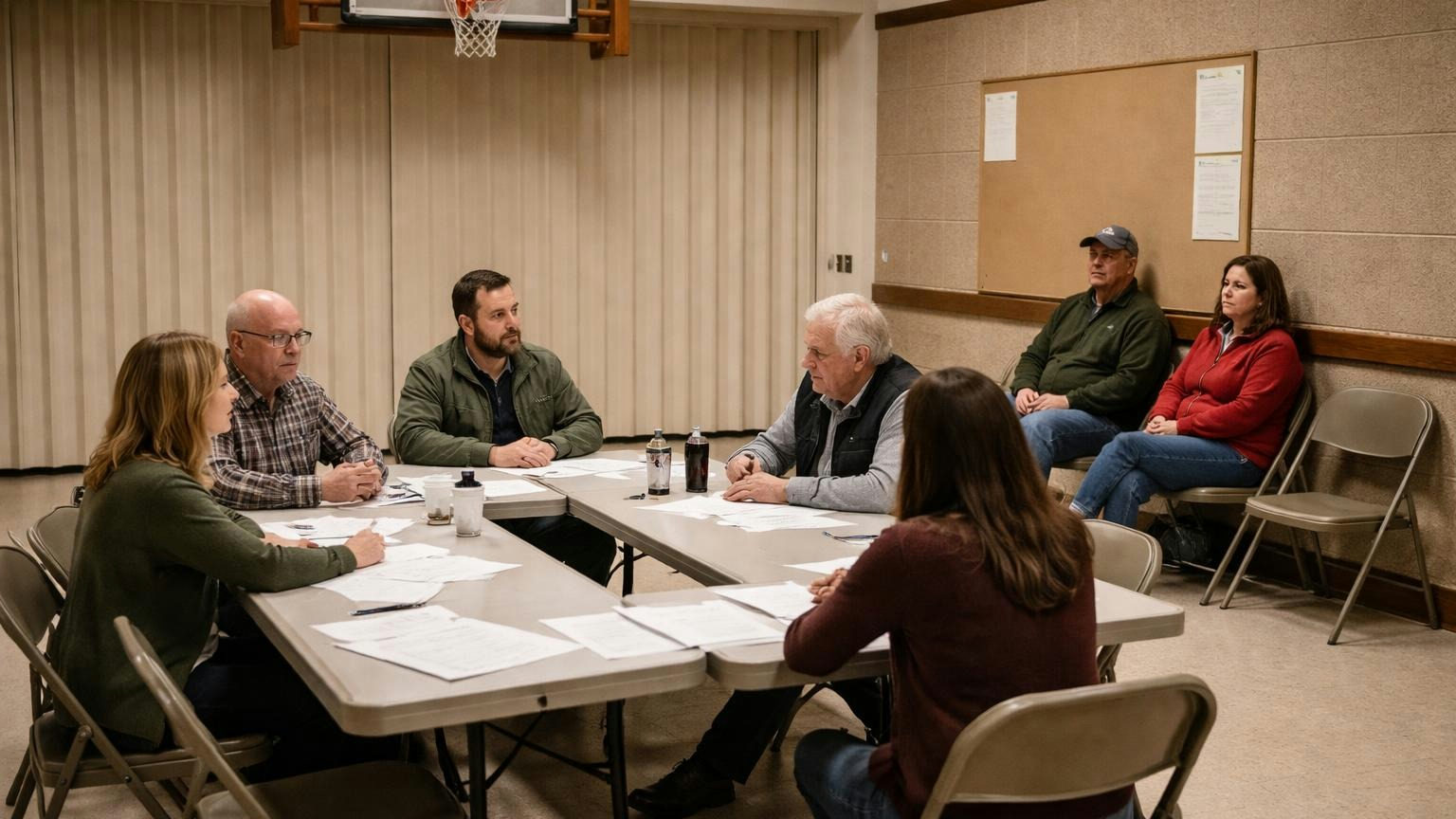
3. Adopt a budget every year, and present it to owners. At least once a year the board prepares and adopts a budget and presents it to the members at a members' meeting (§ 57-8a-215). Owners can disapprove it within 45 days after that meeting, by a vote of at least 51% of all the allocated voting interests, at a special meeting they call for the purpose. If a budget is disapproved, or never adopted, the last budget the board adopted continues until a new one is adopted.

4. Run the reserve analysis on the statute's clock. Unless your governing documents say otherwise, the board has a reserve analysis conducted at least every six years, and reviews and, if needed, updates it at least every three years (§ 57-8a-211(2)). The analysis lists the components that will need reserve money, each one's remaining useful life and cost, the total yearly contribution needed, and a funding plan (§ 57-8a-211(4)). Then the association must:
- give owners a summary of the most recent analysis or update every year, and the full analysis to any owner who asks (§ 57-8a-211(5));
- put a reserve line item in each year's budget, at the amount the board judges prudent from the analysis, or a higher amount the documents require (§ 57-8a-211(6));
- keep the reserve fund separate from other association money, and use it only for its purpose unless a majority of members vote otherwise (§ 57-8a-211(9)).
51% of the allocated voting interests can veto the reserve line item within 45 days after the budget is adopted, at a special meeting owners call. If they do, the association funds reserves at the last line item that was not vetoed. — Utah Code § 57-8a-211(7)

5. Keep the money in the association's name. All of the association's funds go in an account in the association's name, never mixed with anyone else's money (§ 57-8a-230). The records and the money in that account belong to the association (§ 57-8a-227(1)(c)). The check takes a minute: is the account in the association's name, or in the treasurer's?
6. Give notice before you change a rule. Before it adopts, changes or cancels a rule or design criterion, the board (§ 57-8a-217(2)):
- delivers notice to owners at least 15 days before the meeting where it will consider the change;
- gives owners an open forum to be heard at that meeting before it acts;
- delivers a copy of the approved change within 15 days after the meeting.
Only an imminent risk of harm to a person or property lets a board adopt a rule first and give notice after (§ 57-8a-217(3)).
Owners can disapprove the change within 60 days by a vote of at least 51% of all the allocated voting interests, at a special meeting they call for it (§ 57-8a-217(4)). Notice counts as fair and reasonable when it goes by a method the nonprofit act allows, or by a method your documents authorize, including email or text if they say so; an owner can demand mail in writing (§ 57-8a-214).
7. Warn in writing before you fine. A board can fine an owner for violating the governing documents only after a written warning that describes the violation, names the rule or provision broken, says that fines can follow, and, for a continuing violation, gives at least 48 hours to cure (§ 57-8a-208(2)).
How a Utah fine works, step by step.
- Warning: A written warning names the violation and the rule, and gives at least 48 hours to cure a continuing violation
- The fine: It follows only if the owner violates the same rule again within a year, or does not cure it in time
- Hearing: The owner has 30 days after notice of the fine to ask for an informal hearing before the board
- Appeal: The owner may sue within 180 days after the final decision, or after the hearing window closes
The fine must be for a rule or covenant in the governing documents, in the amount the documents set (§ 57-8a-208(3)). At the hearing the board gives the owner a reasonable chance to be heard and allows anyone to join electronically, and, if the owner asked for the hearing in time, no interest or late fees accrue until the owner gets the board's final decision (§ 57-8a-208(4)). A managing agent can run the process, but the hearing itself stays with the board (§ 57-8a-208(6)).
How to Enforce HOA Rules Fairly, From First Notice to Fine

8. Adopt a fee schedule before charging late fees. For a late payment, the board may charge a late fee of no more than the greater of 10% of the assessment or $50, plus interest of up to 1.5% a month on the assessment and the late fee (§ 57-8a-201(4)). Before charging any of it, the board adopts the fee schedule by rule, under the notice process in item 6, and gives a copy to every owner (§ 57-8a-201(5)).
9. Open the records within 10 business days. The association keeps the records the nonprofit act lists, plus its governing documents, its most recent approved minutes, budget and financial statement, its most recent reserve analysis, a certificate for each insurance policy, three years of board minutes, and three years of profit and loss statements and balance sheets (§ 57-8a-227(1)). If it has an active website, the governing documents, the latest approved minutes, and the latest budget and financial statement go on it, free to owners (§ 57-8a-227(2)).
It answers an owner's written request to inspect or copy documents within 10 business days (§ 57-8a-227(4)). Copies cost no more than 10 cents a page and $20 an hour for staff time, or what a copy service actually charged, and documents sent by email are free (same subsection).
$25 a day is what an association owes the owner, for the governing documents, latest approved minutes, or latest budget and financial statement, for each day a request stays unfulfilled, starting the eleventh business day. — Utah Code § 57-8a-227(5)

10. Collect through the lien, within its limits. The association has a lien on a lot for assessments and, unless the declaration says otherwise, the costs of collecting them, including attorney fees, late charges and interest (§ 57-8a-301(1)). A fine joins the lien only after the owner's time to appeal has passed, or a court has upheld it. The association can foreclose the lien judicially, or nonjudicially as though it were a deed of trust, through a qualified trustee it appoints (§ 57-8a-302).
Before a nonjudicial foreclosure, the association sends the owner the statute's notice by certified mail at least 30 calendar days before it records a notice of default, telling the owner they can demand a court foreclosure instead (§ 57-8a-303). It may not foreclose nonjudicially if it skipped that notice, if the owner demands a court foreclosure in time, if the lien includes a fine, or, outside time shares, if the lien includes no assessment more than 180 days past due.
If the declaration, bylaws or rules allow it, a board may cut off a delinquent owner's utility service paid as a common expense, or their use of recreational facilities. It gives notice first, with at least 14 days to pay and the right to ask for an informal hearing, and restores the service as soon as the owner pays (§ 57-8a-309).

11. Explain a denied home-improvement plan in writing. If the association denies an owner's plans for building on or improving a lot, it gives the owner written notice naming each governing document provision it relied on, and the specific part of the plan that does not conform (§ 57-8a-109). A plan review fee may not exceed the association's actual cost of reviewing the plans, and a plan cannot be denied or delayed because it uses fire-resistant material in an area with a heightened wildfire risk.

What the law does not require
- A management company. Nothing in chapter 8a makes a board hire one. The bylaws say what a board may delegate to a managing agent, and an agent can run the fine process, but the fine hearing stays with the board (§ 57-8a-216, § 57-8a-208(6)).
- An outside reserve specialist. The board may conduct the reserve analysis itself or engage "a reliable person or organization, as determined by the board" (§ 57-8a-211(3)).
- Prosecuting every technical violation. The board uses its reasonable judgment, and the association is not required to enforce when the board decides in good faith that, for example, a technical violation is not material or enforcement is not in the association's best interests. It may not be arbitrary or capricious about it (§ 57-8a-213).
- The board amending the declaration on its own. Owners amend the declaration, not the board, and after developer control a majority of voters can adopt an amendment at a meeting where at least 51% of the voting interests are present, unless the declaration requires more (§ 57-8a-104).
What this means for a self-led board
Utah's list is specific, and almost every item is a date: a registration renewed every year, an email 48 hours before a meeting, a rule notice 15 days ahead, a reserve analysis every six years, a records request answered in 10 business days. None of it needs a manager. It needs a calendar the whole board can see and one place where the documents live, so the treasurer's answer to the attorney is "yes, current," not a scramble.

Almost every duty Utah gives a volunteer board is a date. Miss the date, and the statute names the cost.
The takeaway: five things to do this month.
- Look up your association's registration with the Department of Commerce and confirm it is current and correct.
- Confirm your bylaws are recorded with the county recorder, amendments included.
- Find the date of your last reserve analysis and put the next review, three years on, on the calendar.
- Check that a fee schedule was adopted by rule and sent to every owner before any late fee was charged.
- Make sure your fine warning letter names the rule broken and, for an ongoing violation, gives at least 48 hours to fix it.

Frequently asked questions
Does the Community Association Act apply to my Utah HOA? It applies if your declaration says so, or if the declaration does not say which act applies and your plats are not condominium plats (§ 57-8a-103). Condominiums generally fall under Chapter 8, the Condominium Ownership Act.
How much notice does a Utah HOA board owe owners before a board meeting? At least 48 hours, by email, to each owner who has asked for notice, unless the meeting was on a schedule the owner already received or it is an emergency (§ 57-8a-226(2)).
How often does a Utah HOA need a reserve study? Unless the governing documents say otherwise, a reserve analysis at least every six years, reviewed and updated if needed at least every three. The board can do it itself (§ 57-8a-211).
What is the most a Utah HOA can charge as a late fee? The greater of 10% of the assessment or $50, plus interest of up to 1.5% a month, and only after the board adopts a fee schedule by rule and gives every owner a copy (§ 57-8a-201).
This is a plain-language guide, not legal advice. Your governing documents and an attorney licensed in Utah have the final word.
Sources:
- Utah Code Title 57, Chapter 8a, the Community Association Act, as published by the Utah Legislature: le.utah.gov, Chapter 57-8a
- Utah Code Title 16, Chapter 6a, the Utah Revised Nonprofit Corporation Act, § 16-6a-701: le.utah.gov, § 16-6a-701